
The Learning Idiot Index
How Elon Musk’s first principles affect our L&D function


The Fighting Temeraire, J. M. W. Turner (1839), National Gallery of Art, Public Domain; “[Turners’ work] embodies his refusal to be daunted by newness or enslaved by traditional artistic values. His quest to find the beauty and grandeur of modern experience, and leave the past behind.” - Matt Wilson
Picture Elon Musk walking into your learning organization.
He studies your LMS. He reviews your content library. He scans your training calendar, your budget and dashboards. Then he asks one question: “How much value are you actually creating?”
Not courses completed. Not badges earned. Not hours delivered, but Value—improved outcomes.
Then a second question: “If we rebuilt L&D from scratch today, with AI on the table, would we do it the same way?”
Many HR, Talent and L&D leaders would struggle to answer. This is not a failure of smarts or experience. Corporate learning was designed for a world where knowledge was scarce, expertise was hard to attain, and training-in-a-box was the main way to build capability.
That world is ending.
First principles, and the Idiot Index
Musk’s method has a historical name. He calls it first-principles thinking and describes it as a physics way of looking at the world: boil a problem down to what you know is true, then reason up from there.[1] The opposite—reasoning by fads, trends, spin, analogy—means copying what others innocently desire and deploy with incremental tweaks. It is how we get through most days. It is also how whole industries stay expensive.
The idea is classic. Aristotle used the term for the foundational truths a subject is built on; the facts you cannot reduce any further. Reasoning this way means stripping a problem back to those bedrock facts and rebuilding, instead of inheriting the answer everyone accepts or hype demands. Musk’s favorite example is batteries: the industry insisted a pack cost about $600 per kilowatt-hour and always would, until Musk priced the raw materials—cobalt, nickel, aluminum, carbon, a metal can—at roughly $80.[1] The other $520 was not physics. It was convention or commercial theater.
That insight produced a blunt diagnostic. In Walter Isaacson’s biography, Musk calls it the “Idiot Index” or the ratio of a finished product’s cost to the cost of its raw materials. A part that costs $1,000 but contains $100 of aluminum scores a 10 or 10:1 ratio. His verdict is exactly that harsh: “If the ratio is high, you’re an idiot.”[2] He treated anything past roughly ten-to-one or higher as a target.
The label is blunt; the point is not. A high score means the cost lives in the design and the process, not the materials, and this is exactly the cost L&D can attack.
The Learning Idiot Index

In a factory the raw materials are obvious: the aluminum, the steel, the cobalt. In L&D they are less visible but just as real: the expert’s know-how, the process documentation, the policy text, the recorded customer call, the data already sitting in the CRM or ERP system. All of it is valuable. Almost none of it is expensive. Everything stacked on top of it from the analysis, design, the production time, the provisioning, the project management is the “markup” the index measures.
Pointing at L&D, the index stops being abstract.
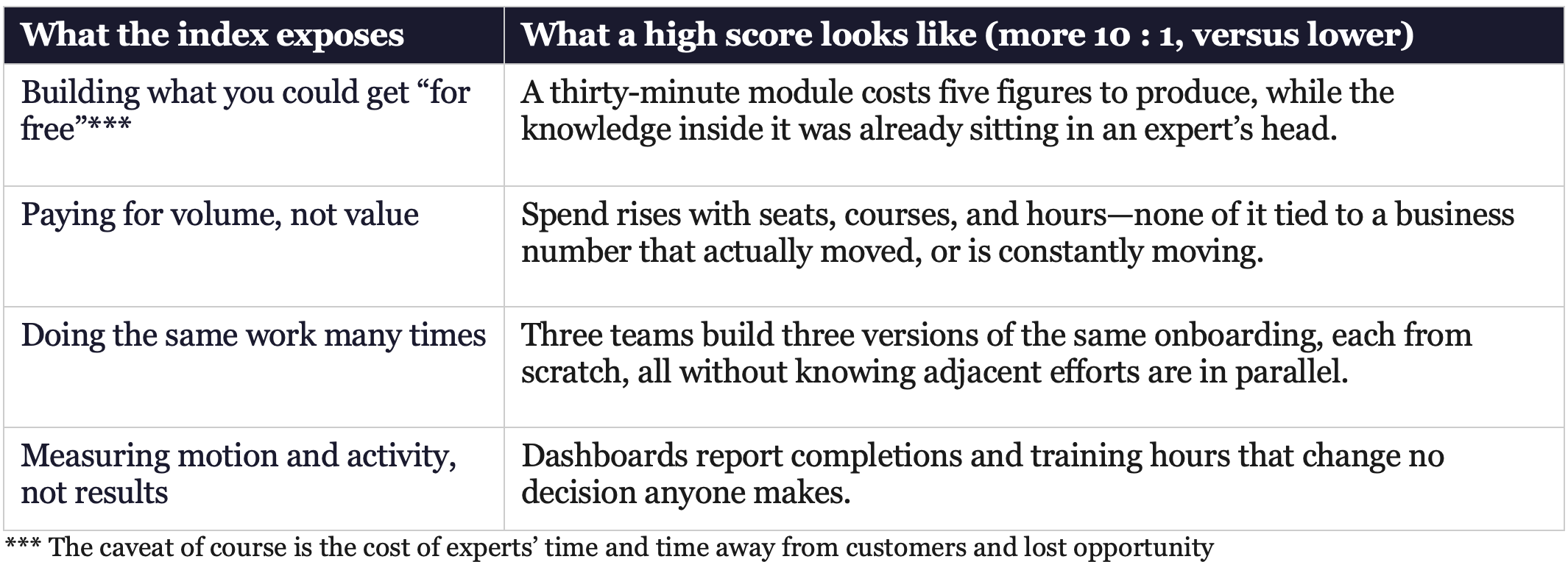
With this grounding in mind…
The intention of this article or argument is therefore to reconsider L&D’s core purpose: provisioning Human Value, and creating Business Value via this new, albeit edgy and necessary provocation.
Now the part that is already resetting every budget: AI.
AI is collapsing this index towards a 1.0 landscape, the point where the finished product costs about what its raw material costs. The labor that used to sit between knowledge and a finished course is now diminishing and disappearing. These examples should not be a surprise:
AI reads raw source material—PDFs, transcripts, documentation—and returns structured lessons, scripts, and quizzes.
Synthetic video and AI voice (tools such as Colossyan) remove the studio, the actors, and the reshoots.
Synthetic personas stand in for the customer, the patient, the difficult stakeholder. People rehearse the hard conversation on demand, with feedback in the moment; no scheduling, no facilitator (Synthetic Users work is fascinating).
The instruction and the information are dynamically assembled, live. Open standards make scattered systems reachable: Anthropic’s Model Context Protocol connects an AI to a company’s tools and data,[3] and Google’s Agent2Agent protocol lets specialized agents hand work to one another.[4] Both are now governed under the Linux Foundation. The result is guidance built from the live system of record at the moment of need, not a course written six months ago, or even 6 weeks ago.
More so, when production cost falls toward zero, content becomes less of a differentiator. If the proudest number from your team this year is hours of learning produced, the index is not improving. It is failing the test entirely.
The waste did not vanish. It just moved.
The denominator tends to be wrong
Every index has two parts, and most of L&D has spent years optimizing the wrong one. The numerator is cost: what it takes to produce the finished thing. The denominator is what you divide that cost into—the thing you measure it against. Here is the mistake: we measured cost against activity—courses built, completions logged, hours delivered—so “good” came to mean producing more of that, more cheaply. But a low cost over the wrong denominator is still worthless. Make a course ninety percent cheaper and all you have is a cheaper version of something lacking value with no business gain, or no one needed.

This is why the denominator now matters more than the numerator. AI is already driving the numerator down on its own. Production is getting cheap whether you act or not. So the contest is no longer cost. It is what you choose to put in the denominator.
There are two flavors of denominators, and naming them clears the confusion. The production denominator is the raw materials or knowledge a course is built from; cost ÷ raw knowledge is the literal Idiot Index, and AI is collapsing it toward 1:1 as content gets cheap to make. This one now takes care of itself. The strategic denominator is the value the work creates; cost ÷ value reads on the same scale where 1:1 means the spend is matched by the value it produces, and 10:1 means you are paying ten times what the work is worth, or worse, considering scaled and wasted labor.
The first is about spending less. The second is about being Worth the spend. AI is handing us the first. We need to win the second.
Putting value in the denominator forces three inherited assumptions into the open, especially when considering AI’s acceleration.
That knowledge must be learned first. A deceptive and classic assumption. It does not need to be, because AI delivers it at the moment of need.
That learning is what builds capability. Sometimes, but so do better tools, redesigned workflows, automation, and a manager who steps in.
That more learning means better performance. Perhaps. Though many functions are superb at producing learning activity and far weaker at producing measured gains.
None of these survive the question: did a business or outcome number move?
The raw materials of L&D and the 21 “worst offenders”
Before fixing the denominator, let’s look at what’s inside. The production denominator—the raw materials a course is built from—is almost always available, abundant, and already in the building. That is the heart of the diagnosis: the materials were never the expensive part, albeit again that an expert’s time, and time away from customers and selling is always a challenge.
The expense is everything L&D stacks on top of them, and the deeper waste is that L&D so often ignores, duplicates, or fails to capture the materials at all, then pays to rebuild what it already had. The table below is the inventory: the “raw”, valuable core, and the critical truth about how each piece gets wasted.
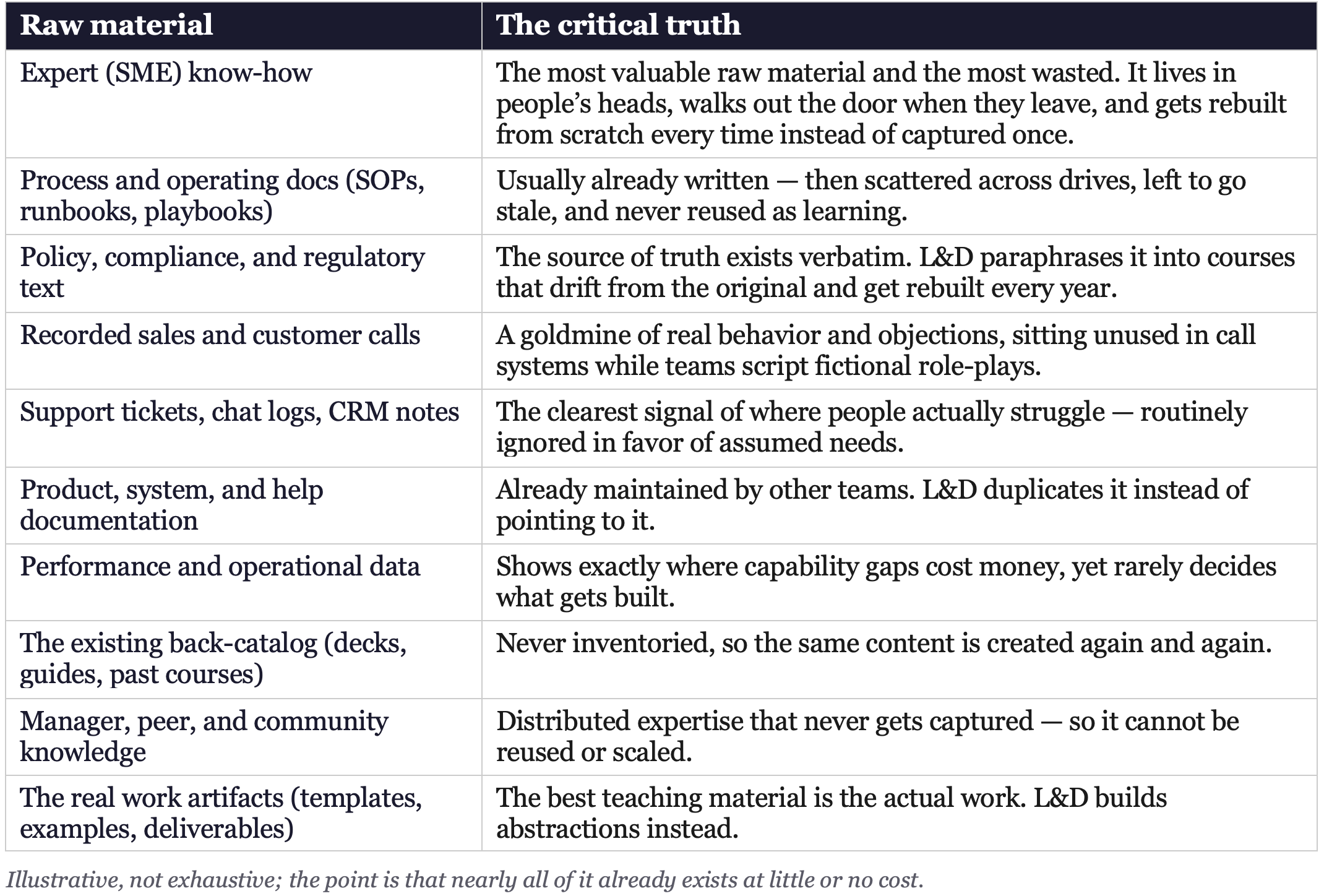
What value creation should really mean…
Start with what every support function tends to miss... Clarity of how the business actually operates. L&D MUST map how the work actually gets done and how the business functions in the trenches; i.e., the real tasks, the real workflows, the everyday places where work, people and AI agents get stuck, the gaps that quietly cost money. Almost no other function holds that mapping more than HR, Talent and L&D. Finance sees the cost. Operations sees the output. L&D can expose the truth.
L&D can see the friction in between, at the level of the task more so than at the skill level. I wrote extensively about this in my series Tasks Versus Skills.
Most of the gain comes from subtraction first. For example, let’s run three lenses across a typical leadership development initiative, and see where we can callout habits to drop, and given AI, we can propose new approaches.
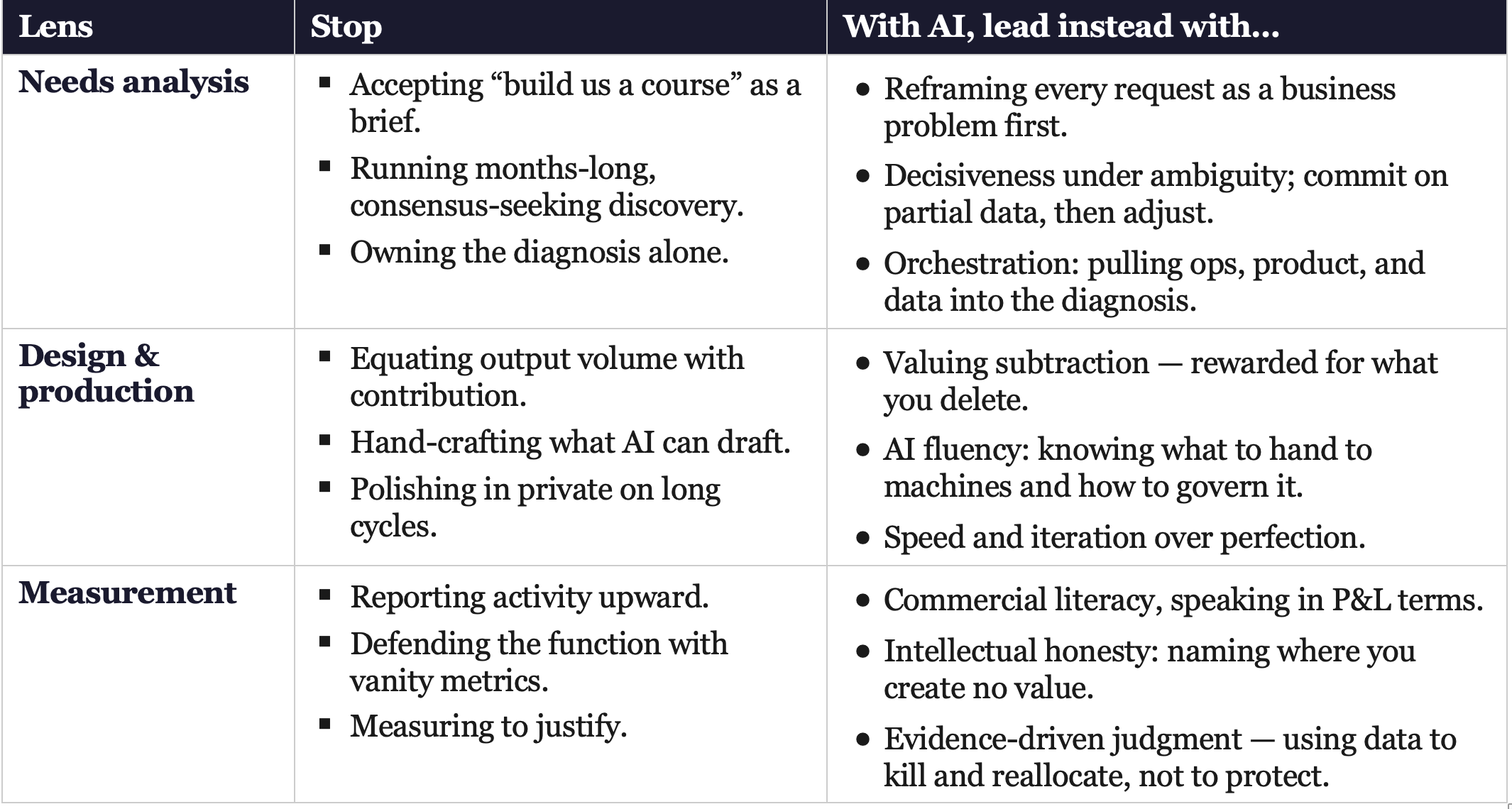
And none of this is new to a workforce operations analyst, business performance analyst, or any Global Head of Learning Insights & Analytics with a similar focus.
As a value-add to the Index’s value intention, we already have four classic frameworks to help us better understand how to operate the Idiot’s Index with a prime focus on cost and value:
Bill of Materials (BOM) analysis. Breaks a finished cost into layers to find where value is actually added, and where it is not.
Make-or-buy analysis. Decides whether to build in-house or buy and asks whether a supplier’s margin is just a tax on your ignorance.
Design for Manufacture and Assembly (DFMA). Simplifies the design itself—fewer parts, fewer steps, lower cost.
Value Stream Mapping (VSM). Maps the flow of work to expose and remove non-value-added steps—waste, duplication, handoffs.
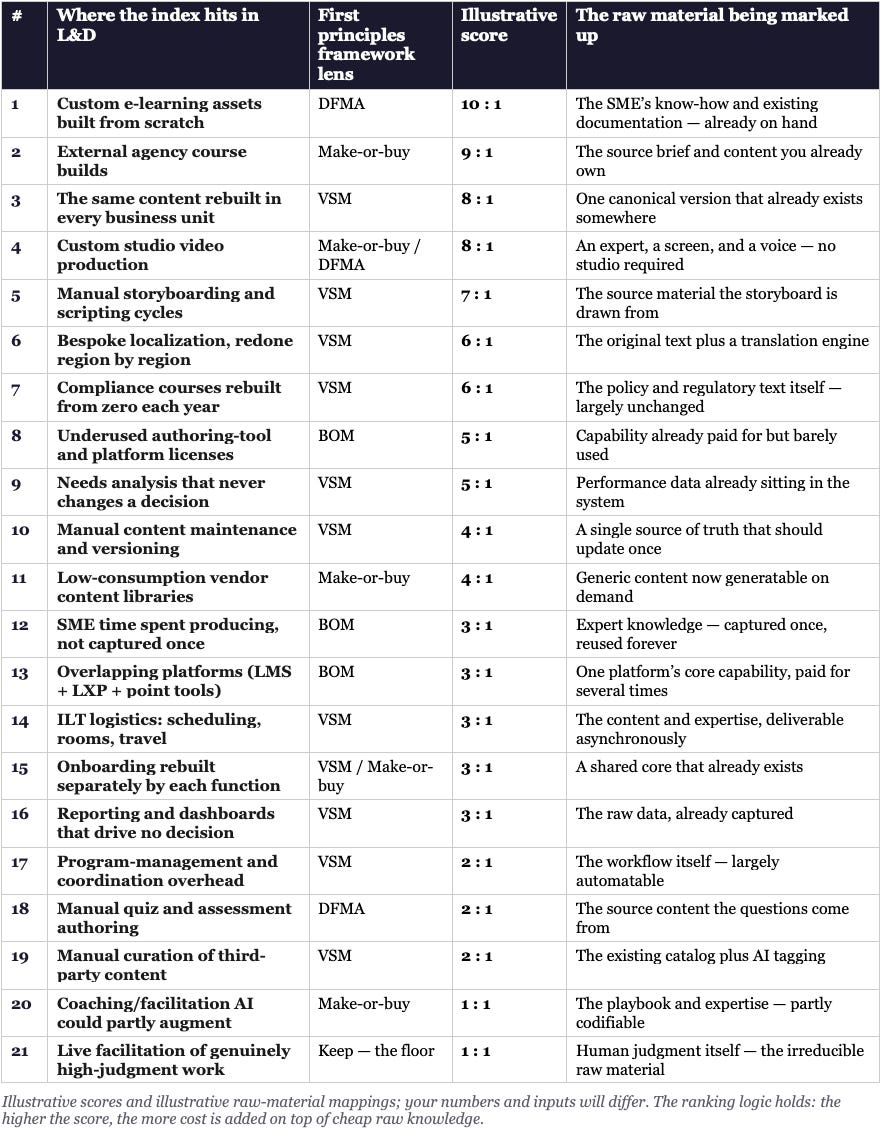
In Isaacson’s Musk biography, a high-ranking SpaceX analyst once came back with a priority list of the worst-offending parts in an engine. Here is my L&D version: twenty-one items the index will sting, ordered worst-to-least, each tagged to the framework whose logic flags it.
The scores are illustrative, your numbers will differ, but the ranking logic holds: the higher the score, the more cost you are adding on top of raw assets and knowledge. [Note a more comprehensive version as Appendix A at bottom showcasing where the “raw material” align with each offender.]
The 21 worst offenders
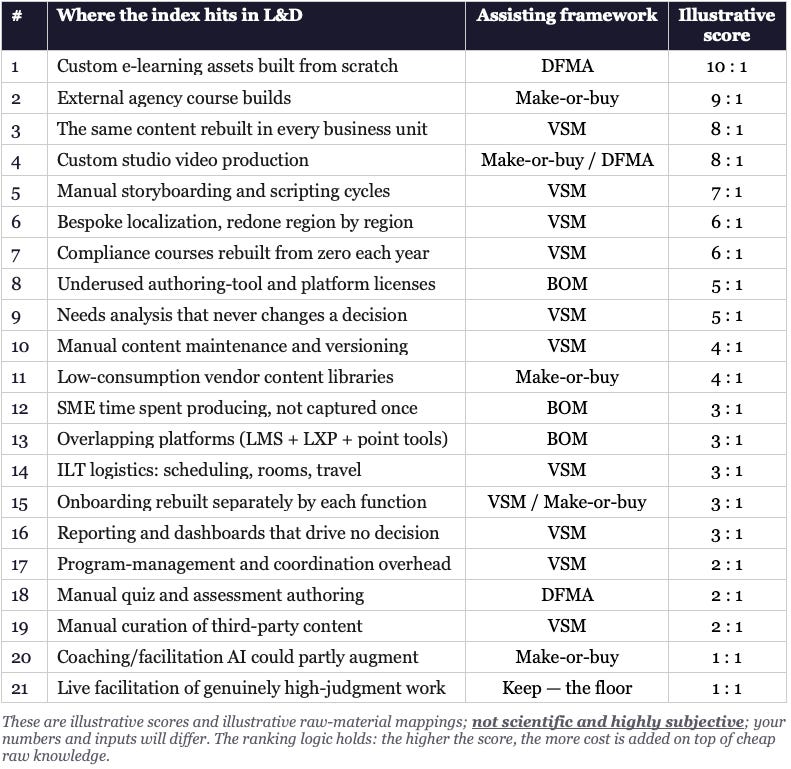
The bottom of the list is the point. The lowest score—the work where cost and value are nearly the same—is the irreducibly human work. That is what you protect, and where the freed-up budget should go.
What the CFO and the CEO would expect of a Learning Idiot Index
Today the conversation about L&D lives in what we can call the current state: cost per head, completion rates, utilization, training ROI. Those are arguably necessary, but they are backward-looking and prone to be defensive. They answer are we efficient? They rarely answer are we creating value? The Idiot Index moves the discussion into a Value State, and that is where it earns its keep with the people who hold the budget.
For the CFO, the index turns a cost line into a managed value lever:
I want a single ratio that trends over time—cost against value, tracked like any operating metric and driven toward its floor.
A map of where spend concentrates with no matching value; a target list for reallocation, not blunt across-the-board cuts.
Every program priced against a named business outcome so learning spend sits on the P&L rather than beside it.
Time-to-proficiency read as earned, value rich productivity.
A defensible basis to consolidate vendors and platforms as the aggregate index falls, and to embed into our vendor renewals logic.
For the CEO, it reads as a strategy input, not a cost report:
I want L&D to be reframed from cost center to a value-and-margin lever; capability per dollar, not dollars spent.
The task-level map of where AI pays off and where human judgment is load-bearing providing a direct input to the whole company’s AI agenda, not just L&D’s.
Visibility into duplicated capability spend across the org or the evidence base for consolidation.
Capability treated as a measurable, compounding asset rather than a political symbol of agreement of an act of corporate faith.
A clear read on which work to automate, augment, or protect—well beyond training.
This is the lesson hiding inside Musk’s index: most leaders treat commercial value or profit as the final responsibility, but profit is downstream. The work is value-addition; turning raw inputs into something more useful, and refusing to let waste consume the difference. Strip out the waste, and the value, and the margin, follow.
L&D’s BFF, and the tool sustaining the relationship
The Procurement team typically owns or approves vendor selection, contracts, and spend governance, which also makes it the function that we should get much closer to and partner on a co-built index. The old relationship was transactional: L&D chose a tool, then came to procurement near the end for sign-off.
The index changes that.
It gives both sides a shared language and pulls Procurement into an end-to-end partnership, guiding make-or-buy calls, the spend audit, and the consolidation plan, and reaching across HR, IT, and Finance. Because the Learning Idiot Index tooling now overlaps all three, AI (data, interoperability, transparency) serves as both broker and validator.
Procurement’s heightened role:
Audit what you already buy. Run every vendor agreement through the index: finished cost over the value it still uniquely provides. Generic content libraries you could now generate, agency fees for builds AI can draft, per-seat platforms tied to no outcome—these score high, and are the first to renegotiate, consolidate, or cut.
Further screen what you are about to buy. The test for a new vendor is simple: does it lower your index, or just add production capacity? Reject the ones selling volume. Favor the ones that move an outcome, and ask them to price against value, not seat time.
NEW - 2026 AND BEYOND: Use it to redraw the org structure. Run the index across the whole company and the duplication is obvious; every function building its own content at a high aggregate score. As companies centralize or federate L&D, procurement is the function that executes the rationalization: consolidate the production, data, and AI layer into one center (or a federated model with shared standards) so knowledge is built once, governed once, and delivered everywhere. Local teams stop manufacturing content and focus on application and judgment.
The index is the tool both functions should hold in common. L&D uses it to decide what to build, buy, or kill. Procurement uses it to audit, negotiate, and consolidate. Pointed at the same spend, they reach the same valuable answer faster.
An objective gap to consider though, is setting a realistic range or “Efficacy Range Ratio” model that both teams can use as a target or where to set the instructional design bar (“an ideal or acceptable ratio can be between 1:4 and 1:10… anything beyond 1:10 is under scrutiny…”), and leverage this model as a rubric for agreement.
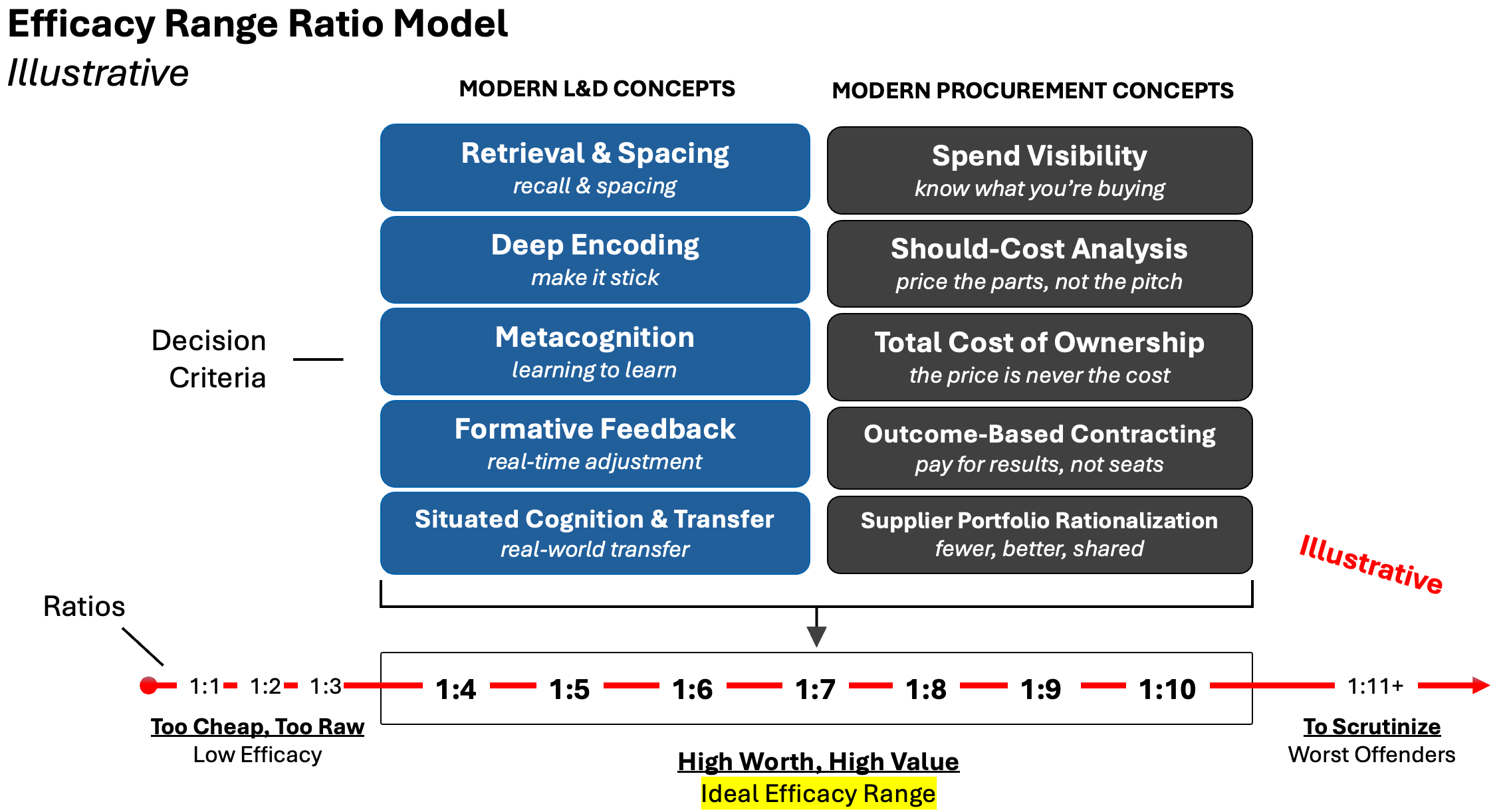
[Concept definitions in appendix B]
Our charter
It would be easy to read all of this as a case for shrinking L&D. It is the opposite. Strip out the low-value production, and what remains is the work only humans can do—helping others adapt, make sense of change, build judgment, and stay whole while the ground moves under them. This also allows L&D to fill gaps in knowing how the business truly operates (a Forward Deployed Learning Architect example here). That has always been the real charter: help humans thrive.
L&D MUST get closer to how the business operates and sustain—above all things—culture and commercial viability.
The hardest part of this is not building something new. It is having the nerve to stop. Stop counting completions. Stop defending the content factory. Stop reaching for a course before anyone has named the problem. Each of those is a line a CFO can already see, and each one is value you are not creating.
Now that AI has made production nearly free, and everyday execution evolving into a commodity, what you choose not to build is worth more than what you ship.
Subtraction is the boldest move a learning leader has left. Value creation is no longer the aspiration; it is the price of admission. The learning teams still standing in three years will be the ones that stopped measuring their effort and started PRICING THEIR IMPACT.
We spent decades possibly perfecting the wrong craft. We got very good at pushing training and expecting transfer and application. Yet, learning was never the absolute product. Value was.
It always was.
This article was inspired by terribly smart colleagues Dushyant Pandey, Darren Galvin and Orsi Hein; researched, assembled and cowritten by Claude Sonnet 4.8, ChatGPT and Gemini 3.5
All em dashes—are mine.
The views and opinions expressed in this article are solely those of the author and do not necessarily reflect the views of the author’s employer or any affiliated organizations.
Licensing
Unless otherwise noted, the contents of this series are licensed under the Creative Commons Attribution 4.0 International license; CC0 1.0 Universal (CC0 1.0) Public Domain Dedication.
Should you choose to exercise any of the 5R permissions granted you under the Creative Commons Attribution 4.0 license, please attribute me in accordance with CC’s best practices for attribution.
If you would like to attribute me differently or use my work under different terms, contact me at https://www.linkedin.com/in/marcsramos/.
Artwork
The Fighting Temeraire, J. M. W. Turner (1839), National Gallery of Art, Public Domain; “[Turners’ work] embodies his refusal to be daunted by newness or enslaved by traditional artistic values. His quest to find the beauty and grandeur of modern experience, and leave the past behind.” - Wilson, Matt (17 April 2025). "The Fighting Temeraire: Why JMW Turner's greatest painting is so misunderstood". BBC culture. Retrieved 20 April 2025.
Appendix
[A] The 21 worst offenders — comprehensive view
Four referenced frameworks:
Bill of Materials (BOM) analysis. Breaks a finished cost into layers to find where value is actually added, and where it is not.
Make-or-buy analysis. Decides whether to build in-house or buy and asks whether a supplier’s margin is just a tax on your ignorance.
Design for Manufacture and Assembly (DFMA). Simplifies the design itself—fewer parts, fewer steps, lower cost.
Value Stream Mapping (VSM). Maps the flow of work to expose and remove non-value-added steps—waste, duplication, handoffs.
[B] L&D and Procurement concept definitions
L&D
Retrieval & Spacing / recall and spacing. Strengthening memory by recalling information over spaced intervals rather than cramming it once. What isn’t retrieved fades, which is why one-and-done training carries a high ratio: cost goes in, little capability stays.
Deep Encoding / make it stick. Processing material for meaning and connection rather than surface familiarity, so it lasts and transfers. Shallow content is cheap to produce but creates little durable value; a high Idiot Index hiding behind completion rates.
Metacognition / learning to learn. Helping people see what they know, what they don’t, and how to direct their own learning. It shifts spend from pushing content toward building self-sufficiency, which compounds in value over time.
Formative Feedback / feedback. Giving learners low-stakes, in-the-moment feedback that lets them correct course while they work, not after. Feedback during the work is where learning converts into performance — the value the spend is supposed to buy.
Situated Cognition & Transfer / real-world transfer. Designing learning in the actual context of the work so it carries over to the job. Capability that never reaches the workflow creates no value, no matter how polished the course; i.e., the classic high-ratio trap.
Procurement
Spend Visibility / know what you actually buy. A complete, current map of who you pay, for what, and where it overlaps across the organization. It’s the prerequisite for the Idiot Index. You can’t cut duplication or spot a high-ratio vendor you can’t even see.
Should-Cost Analysis / price the parts, not the pitch. Building a bottom-up estimate of what something ought to cost from its underlying inputs, rather than accepting the quoted price. This is the Idiot Index in negotiation form: decompose the cost and ask how much is real value versus supplier margin on cheap raw materials.
Total Cost of Ownership / the price is never the cost. Counting the full lifetime cost of a purchase including integration, admin, training, renewals, switching; not just the sticker price. A low headline price can still carry a high true ratio once the hidden costs are added.
Outcome-Based Contracting / pay for results, not seats. Structuring agreements so payment is tied to measured outcomes rather than volume of licenses, hours, or activity. It forces the value into the denominator: the vendor is paid for what moved, not for what was delivered.
Supplier Portfolio Rationalization / fewer, better, shared. Consolidating overlapping or low-value vendors into a leaner, governed set of partners. Duplication is where the aggregate Idiot Index is highest, so this is usually the fastest, largest reduction available.
References
[1] Rose, K. (Host). (2012, September 7). Foundation, episode 20: Elon Musk [Video]. Revision3. https://archive.org/details/KevinRoseInterviewsElonMusk — Source of the battery example and the “physics” framing of first-principles reasoning; the ~$600 vs. ~$80 per kWh figures are Musk’s own from this interview.
[2] Isaacson, W. (2023). Elon Musk. Simon & Schuster. https://www.simonandschuster.com/books/Elon-Musk/Walter-Isaacson/9781982181284 — Source of the “idiot index” definition, the $1,000 / $100 illustration, and the exact quote, “If the ratio is high, you’re an idiot.” The ~10:1 threshold is a commonly cited reading of the book, not a verbatim figure.
[3] Anthropic. (2024, November 25). Introducing the Model Context Protocol. https://www.anthropic.com/news/model-context-protocol — Open standard connecting AI models to external tools and data. Subsequently donated to the Linux Foundation’s Agentic AI Foundation (Dec. 2025): https://www.anthropic.com/news/donating-the-model-context-protocol-and-establishing-of-the-agentic-ai-foundation
[4] Google. (2025, April 9). Announcing the Agent2Agent protocol (A2A). Google Developers Blog. https://developers.googleblog.com/en/a2a-a-new-era-of-agent-interoperability/ — Open standard for agent-to-agent communication. Donated to the Linux Foundation in June 2025: https://developers.googleblog.com/en/google-cloud-donates-a2a-to-linux-foundation/
[5] Chapman, B. (2010). How long does it take to create learning? [Research study]. Chapman Alliance. http://www.chapmanalliance.com/howlong — Development-time benchmarks: roughly 43 hours per finished hour for instructor-led training and ~79 for basic (Level 1) e-learning, rising to ~184 and beyond (up to 700+) for highly interactive courses. Widely cited field estimates; treat as approximate. Stable archived copy: https://www.cedma-europe.org/newsletter%20articles/misc/How%20long%20does%20it%20take%20to%20develop%20training%20by%20Brian%20Chapman%20(Sep%2010).pdf
[6] Rother, M., & Shook, J. (1999). Learning to see: Value-stream mapping to add value and eliminate muda. Lean Enterprise Institute. https://www.lean.org/store/book/learning-to-see/ Boothroyd, G., Dewhurst, P., & Knight, W. A. (2011). Product design for manufacture and assembly (3rd ed.). CRC Press. https://www.routledge.com/Product-Design-for-Manufacture-and-Assembly/Boothroyd-Dewhurst-Knight/p/book/9781420089271 — Standard frameworks behind the index. Value Stream Mapping (VSM) is from Rother & Shook; Design for Manufacture and Assembly (DFMA) from Boothroyd, Dewhurst & Knight. Bill of Materials (BOM) cost analysis and make-or-buy analysis are foundational operations-management concepts with no single canonical source. Index scores in the table are illustrative, not measured.