
AI Is Making Knowledge Management Strategic Again
And L&D is the function with the cognitive science, cultural mandate and revitalized attitude to lead the revival

The conditions for knowledge management to matter more strategically are better right now than they have been in several years. The discipline has serious intellectual roots and a long history of working models inside knowledge-intensive organizations, even if its day-to-day application has often been narrowed to portals and document repositories. The need, intention and benefits behind it has not gone away. Knowledge management as a function has been waiting for a new renaissance.
That moment has arrived.
Knowledge management (KM) has always mattered in knowledge-intensive industries. Pharma, financial services, energy, law, aerospace, and professional services have invested in KM for decades because the cost of not knowing and the cost of not sharing has always been high in those sectors. The same KM disciplines that supported regulated documentation, expert directories, and lessons-learned systems are turning out to be exactly what makes enterprise AI usable. The gains are critical even when they are not yet visible in today’s headlines.
Knowledge management -- its data, its tacit expertise, its culture of sharing and curating -- is also a missing ingredient in many L&D-led AI transformations. And L&D is the function with both the cognitive science fluency, cultural mandate, and a fresh attitude to lead the revival.
Some context: What does knowledge management do and what’s the economic case?
A short primer. Knowledge management, as a function inside a large enterprise, is the practice of identifying, capturing, organizing, sharing, and renewing what an organization knows so that the right knowledge reaches the right people at the right moment in their work. In day-to-day terms this includes maintaining searchable knowledge bases and taxonomies, running expert directories and communities of practice, capturing lessons learned after major projects, supporting onboarding with curated institutional memory, providing more efficient customer support, and increasingly, preparing knowledge for AI retrieval systems. The function exists wherever the cost of not knowing something is high and derisking customer and economic success.
How KM operates varies meaningfully by industry. In pharma and life sciences, it is heavily oriented around regulated knowledge -- clinical study reports, GxP documentation, safety signals. In oil, gas, and energy, the focus is technical communities and operational lessons from high-consequence environments. In consulting and professional services, KM operates closer to a knowledge marketplace, with experts, methods, and case histories as the primary assets. Etc. The shape varies. The underlying job making expertise findable, useful, and renewable, does not.
Knowledge management -- and more importantly, the knowledge assets KM produces and stewards -- falls squarely inside what economists and strategists call intangible assets or “organizational capital”, that is…
“… The knowledge used to combine human skills and physical capital into systems for producing and delivering want-satisfying products.” - The Measurement of Firm-Specific Organization Capital”
Ocean Tomo’s 2026 Intangible Asset Market Value study found that intangible assets now constitute approximately 92% of S&P 500 market capitalization as of year-end 2025, up from 17% in 1975. That is not an incremental shift. Patents, brand, software, data, customer relationships, organizational know-how, and culture are the assets that now define enterprise value. Tangibles like manufacturing facilities, inventory, and equipment for example make up the remaining 8%.
Tacit knowledge, the experiential, judgment-rich, context-bound knowing that Michael Polanyi summarized as “we can know more than we can tell”, is the most valuable form of this intangible capital [2]. It is also the form least visible on any balance sheet and least amenable to capture. Accounting standards do not yet monetize a senior engineer’s intuition about why a process is drifting. A relationship manager’s pattern recognition for which client is about to leave, or a clinician’s diagnostic instinct refined over a decade of cases may not be harvested. Yet it is precisely those tacit assets that determine whether AI delivers useful answers or confidently wrong ones.
Why AI needs KM to work
There is now a strong consensus in the AI engineering community that getting useful enterprise AI requires grounding the models in the company’s own knowledge. The architectural pattern is often referred to as retrieval-augmented generation or RAG, and its quality is bounded entirely by the quality of the knowledge it retrieves from. Foundation models trained on the open internet do not know your safety procedures, your client-handling protocols, your unwritten escalation paths, or your library of edge cases. Without grounding, they produce confident, articulate answers that sound right and are not.
The grounding problem becomes most acute exactly where the stakes are highest. Knowledge-intensive and IP-sensitive industries requiring tacit expertise has historically been hard to externalize. McKinsey research has consistently found that the average interaction worker spends an estimated 20% of the workweek searching for internal information or tracking down colleagues, with structured social and knowledge tools capable of reducing that search time by as much as 35%[4]. That number has barely moved in a decade. An AI assistant or copilot bolted on top of fragmented, undocumented, contradictory knowledge will not move it either.
The companies seeing real productivity gains from AI tend to be the ones that did the unglamorous knowledge work first. Their AI sits on top of curated lessons learned, active expert networks, well-tended communities of practice, and clean taxonomies.
AI is multiplying real institutional knowledge, not generating plausible substitutes for it.
Document management is not knowledge management. Here is the conceptual error that has narrowed KM’s contribution for two decades. Document management is about storage and retrieval of artifacts. Knowledge management is about the creation, transfer, and renewal of expertise. They are different categories. A SharePoint site is to knowledge management what a parking lot is to transportation: useful infrastructure that may or may not have anything to do with the actual outcome.
Nonaka and Takeuchi made this distinction definitively in 1995. Their SECI model — Socialization, Externalization, Combination, Internalization — describes knowledge as a continuous conversion between tacit and explicit forms [3]. The point of the spiral is that knowledge is created in motion, shared in practice, articulated in dialogue, combined into new explicit forms, and re-internalized into individual practice.
Knowledge is a verb, not a noun. Treating it as a noun, as documents in a system, captures only the residue of knowing, not the knowing itself.
Core to a L&D- and KM-infused culture: Teaching Is Learning Twice
The most powerful KM mechanism ever identified is the act of teaching. Bargh and Schul demonstrated in 1980 that learners who expected to teach material remembered it significantly better than passive learners [5]. As Fiorella and Mayer share in The relative benefits of learning by teaching and teaching expectancy, even the expectation of teaching improves learning, and that the act of explaining to others produces deeper organization of knowledge, integration with prior learning, and more durable retention [6]. The phenomenon now has a name in the educational psychology literature, the protégé effect, and its mechanism is well-characterized: preparing to teach forces explicit organization of tacit understanding; generating an explanation forces selection and structuring of the relevant ideas, and interacting with a learner forces real-time integration of feedback.
For the modern enterprise, every act of teaching is simultaneously an act of knowledge fortification and externalization, a deepening of the teacher’s own expertise, and a contribution to the organization’s tacit-to-explicit conversion process. A company where experienced people regularly teach is a company continuously externalizing its tacit assets, without anyone ever opening a KM strategy document. This is something I managed and participated in at Google years back; a program called g2g or Googler-to-Googler encouraging any Googler to teach any (reasonable) topic, gain recognition, support our employee-led learning practices, and especially go deeper on a learning goal.
Broadly, Culture is what makes this work. A culture that values teaching, sharing, curating, and crediting expertise produces externalized knowledge as a byproduct or KM asset of doing the work. A culture that hoards, that treats expertise as personal leverage, or that rewards individual heroics over collective uplift, produces no value no matter how many SharePoint sites get stood up.
L&D has an unusual standing on this terrain. Cognitive science, retrieval practice, metacognition, the social construction of expertise… these are L&D’s intellectual home. My wager: no other function in the modern corporation carries the same combination of pedagogy, behavior change, and culture work in its skills and capabilities stack. IT can build the retrieval architecture. HR can run the engagement surveys and employee experience programs. Communications can publish the messaging. L&D, though, is uniquely positioned to do the grunt and glory work of shifting a culture toward teaching, and it’s that cultural shift that produces the externalized tacit knowledge AI systems will have something useful to retrieve.
If L&D evolved “courses” into “products” with KM as a partner, what would they look like?
Treating learning as a product is the right instinct. The L&D community has already imported some marketing thinking such as personas, journeys, value propositions, brand from the customer experience world [12]. But a current product orientation seems incomplete. It treats the learner as the customer and the course as the product, with the catalog as the storefront. That framing feels correct, yet it’s static, incomplete and leaves most of the value on the table.
A serious learning-as-a-product orientation — led by Information Assets (KM) aad Instructional Frameworks (L&D) — pulls in disciplines we have only partly absorbed: product marketing and product management. Both are essential, and both need KM as an equal partner to work.
My take:
Product marketing is the discipline of identifying user needs, segmenting users, positioning the offering against the alternatives users actually choose, articulating a value proposition, and generating demand. Most L&D shops do persona work for identifying the best use cases per role or “everyday” scenarios to practice. Yet:
Few run the equivalent of win/loss analysis on capability gaps
Few position their knowledge access against the alternatives workers actually use such as Google, ChatGPT, social media, the colleague down the hall, the SharePoint site they gave up on a year ago
Few treat their internal brand as a competitive asset against shadow learning
Few embed their own Marketing team’s practices and principles to truly “think like a marketeer” [13]
Product marketing thinking, applied seriously, changes how L&D understands its market. Are we positioned as the place workers go for capability, or as the place workers go because compliance requires it? Those are different brands.
Product management is the discipline of continuous discovery, hypothesis testing, instrumentation, lifecycle management, and predictability. This is the part L&D has barely touched and an opportunity to connect with KM practices and principles.
Product managers do not ship a catalog and walk away. They run discovery cycles, observe behavior, measure retention and engagement signals, sunset what isn’t working, and operate on the assumption that user needs change. Capability needs in an AI-disrupted workforce are arguably the most dynamic user needs in any function. L&D shops without product management discipline will keep shipping artifacts that meet last year’s need, and will keep being surprised when the workforce routes around them.
KM is the equal, yin and yang partner that completes the picture. Product marketing without KM treats the course as a canned product. Product management without KM treats the LMS as the platform. Both stop at the explicit layer. KM brings the tacit layer into the product surface — experts, precedents, communities, lessons, patterns — and makes the product something more than a content catalog with better positioning. Information becomes useful when paired with instruction. Instruction lands when grounded in real knowledge. KM and L&D are the two sides of that pairing.
The pairing is concrete. Every knowledge asset has a skill-attainment counterpart, and AI now strengthens both sides at once.
Informational + Instructional + AI Siblings
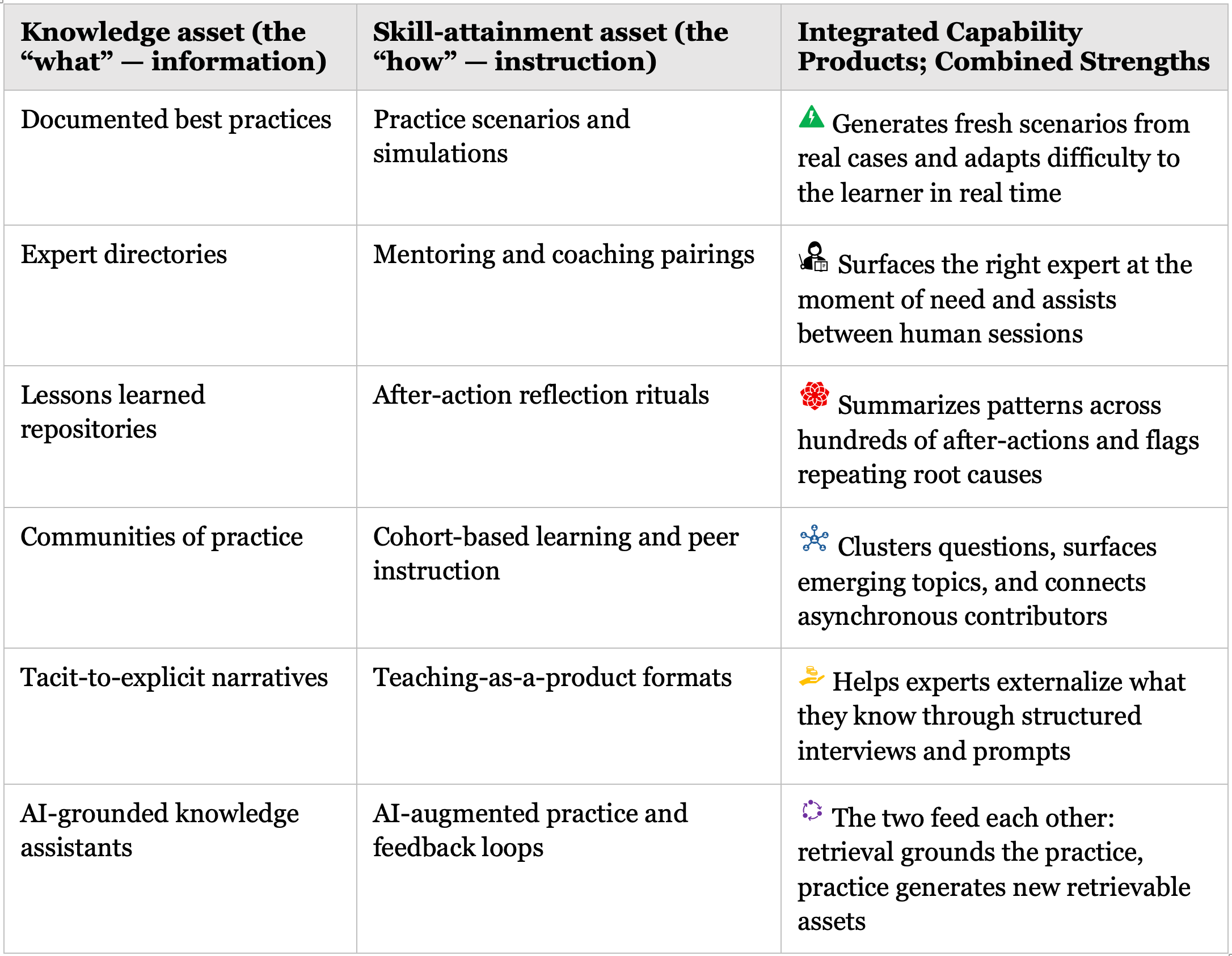
AI is what collapses what used to be two separate workstreams — KM teams building the left column, L&D teams building the middle column — into Integrated Capability products. Imagine a lesson learned plus a practice scenario plus an AI tutor that grounds in both is a different product than either column alone. The informational grounding gives AI something true to retrieve. The instruction fuels AI to challenge, provide just-in-time support and build mental muscle that instills human confidence and agency.
The pairings of Information and Instruction, and Product Marketing and Management, together, compound.
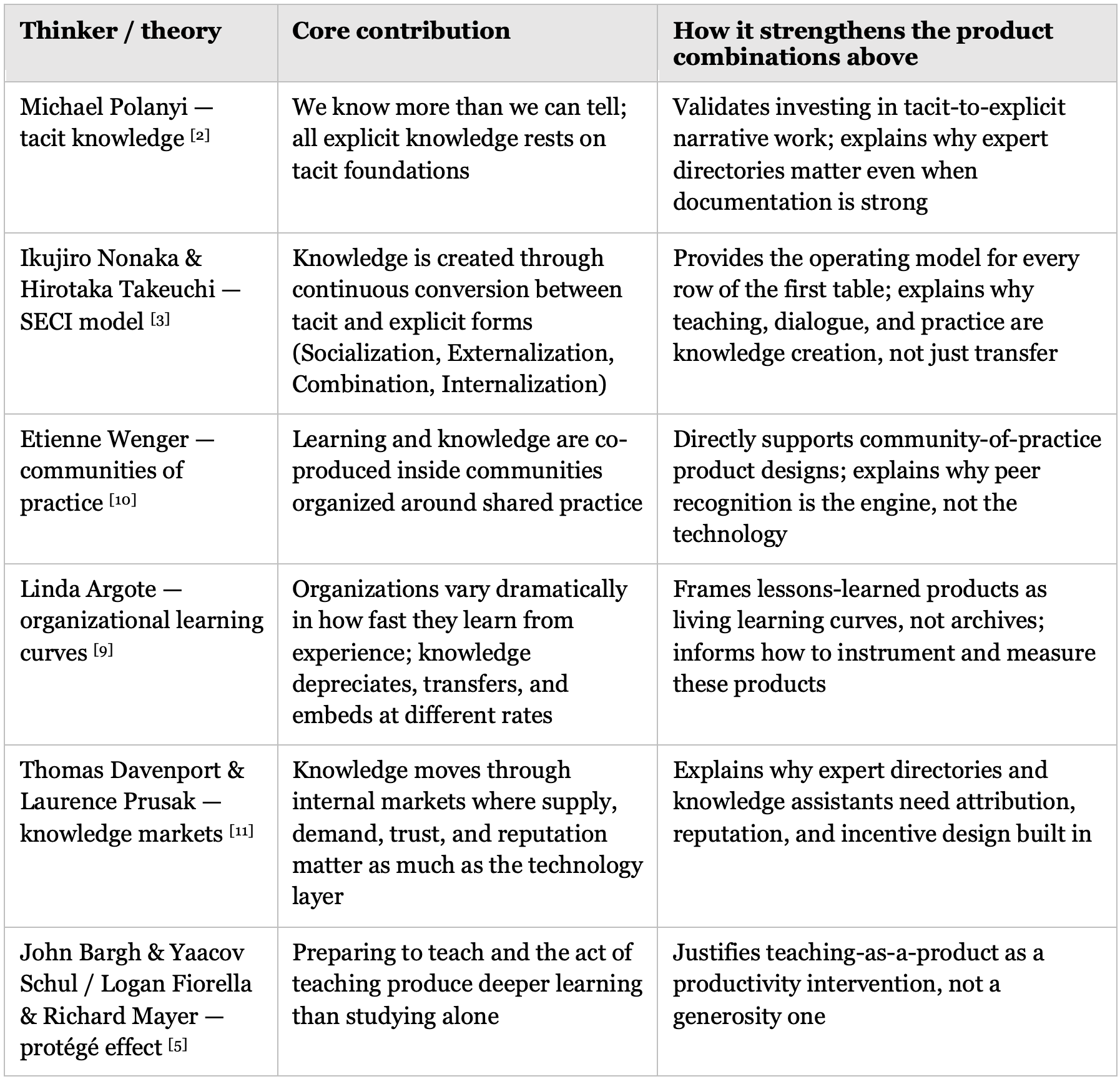
The intellectual tradition of KM maps directly onto these product combinations. The experts and theorists previously mentioned, and more are not academic decoration; their work tells L&D leaders what to build, and why each piece holds together. [See Appendix A for a their contributions and complement with these pairings.]
What this looks like in practice is a set of six product categories that look different from today’s course catalog.
Six product category examples:
Expert directories with built-in coaching integration — not org-chart listings, but contribution-weighted profiles tied to mentoring availability, with AI matching that improves over time and tracks related KM assets or Googler-to-Googler-like hours or unleashed expertise ours. .
Living lessons libraries — captured from real project after-action meetings and contributions, summarized by AI, indexed by pattern, trend analysis, retrievable both by humans and by AI tutors during the next similar project.
Community(s)-of-practice platforms with explicit recognition and credit mechanics — peer-elevated and peer-to-peer scoring, with AI clustering emerging topics, connecting members across geographies and bite-sized assets dynamically provisioned via MCP and A2A protocols; i.e., identifying the right asset for the right need.
Onboarding memory products — institutional context for new hires that combines tacit narratives told by experienced people, explicit documentation curated by KM, and practice opportunities designed by L&D, all delivered through an AI assistant grounded in real precedent.
Teaching-as-a-product formats — structured opportunities for experts to teach, with AI teaching assistants (Socratic, operational), and AI-assisted documentation so the teaching effort produces durable assets.
Capability AI assistants — workforce-facing AI grounded in the company’s actual knowledge fabric, with attribution to real sources (e.g., human and agentic), supervised by human experts, and continuously improved through usage telemetry.
Each of these is simultaneously a KM product and an L&D product. None is a course, and as I’ve written before, the current version of a course with fixed duration, fixed objectives, fixed roles and activities, will go away. Instructional and informational “content” will be drastically reduced and deployed in-the-famous-flow-of-work; that is dynamically provisioned and personalized.
All L&D products will require the product marketing and product management disciplines named above to succeed over time. None are finished at launch. Each will operate on a product lifecycle, with discovery, instrumentation, iteration, and eventual sunsetting built in.
The shift in mental models is the point. The worker is not the learner. The worker is the learning consumer eager to make better decisions. The “product” is access to the right capability at the right moment, in whatever form works including explicit content, tacit narrative, human expert, AI assistant, community thread, practice scenario. Knowledge management and learning and development are the two sides of the same coin, or product.
The worker is not the learner. The worker is the learning consumer eager to grow to make better decisions.
Measuring the new model
The traditional measurement frameworks have served us well. Donald Kirkpatrick’s four levels [13], Jack Phillips’s ROI methodology [14], and APQC’s KM measurement guidance [15] have given L&D and KM functions decades of useful structure. They were designed for a world where the unit of measurement was duration, course completion, a knowledge base, KM assets built and consumed etc.
If we are now treating Information + Instruction + AI as a single product — built and shipped by an integrated team, marketed to a workforce, refined continuously over a lifecycle — those traditional frameworks are no longer the right ones.
This is a meaningful shift. Kirkpatrick was useful. So was Phillips. So was APQC. None was designed for what we are now building. The measurement frameworks that fit the new model come from product marketing and product management; the same disciplines that have given modern brands and platforms their measurement rigor.
[See Appendix B at how one of the world’s largest Marketing companies, WPP measures the success of WPP Open, its AI marketing platform.]
Two dimensions matter. Product marketing measures whether the product is perceived, considered, and chosen against the alternatives. Product management measures whether the product is used, retained, and delivering value over its lifecycle. Both are essential. Both have well-developed metric vocabularies that L&D can adopt directly.
Table A. Product marketing measures of success: Information + Instruction + AI as a product
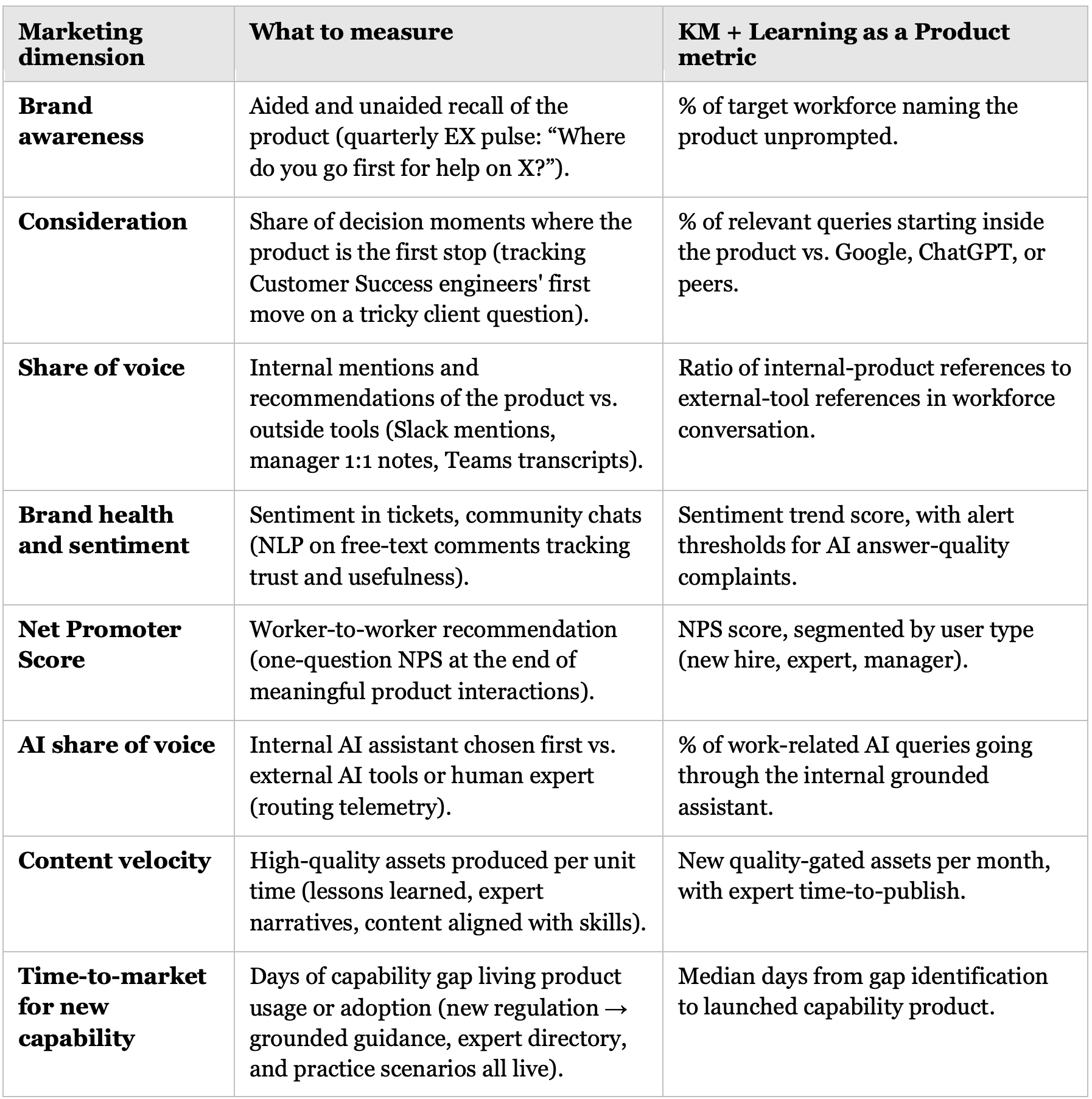
Table B. Product management measures of success: Information + Instruction + AI as a product
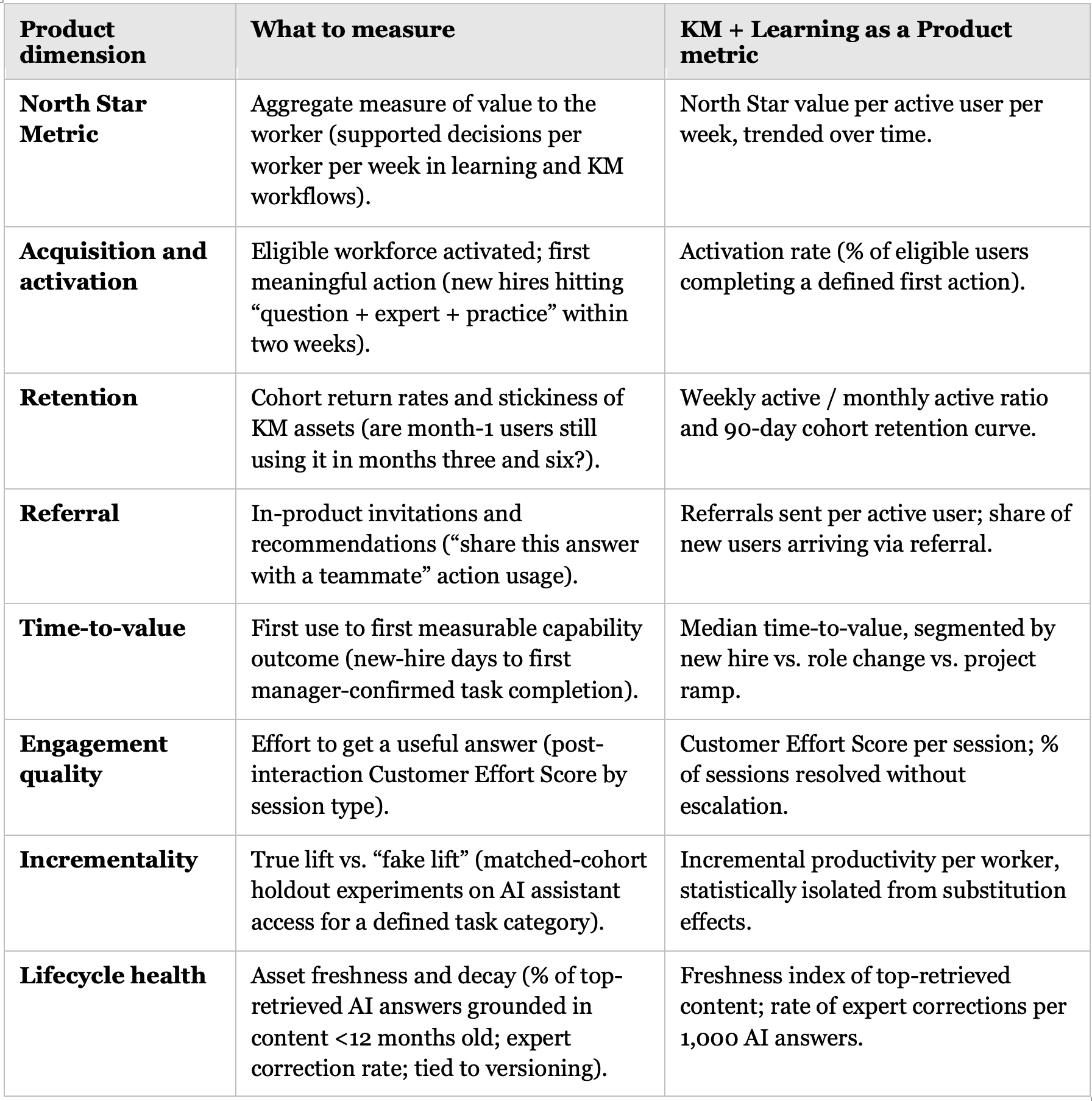
The two tables together represent a different measurement contract than L&D has traditionally signed. The old contract: report on course consumption, completion hours, butts-in-seats, satisfaction, assessment scores and more. The new contract is: report on product adoption, retention, brand strength, incremental value created, lifecycle health, human agency and more. [See Appendix C for 4 new Human Agency metrics that should be in every Talent and L&D survey.]
The first is a support function reporting up. The second is an L&D product-centric team reporting like any other product team in the company.
Summary, L&D leaders should consider five steps in the next few quarters, none of which require reorganization.
First, audit the company’s tacit assets as deliberately as Finance audits cash assets. Where are the people whose retirement would create a capability cliff? Where are the workflows that survive only because three people happen to know the workaround? Where is the institutional memory that is one reorganization away from being lost?
Second, install teaching as a cultural ritual, not an event. Every senior expert should be teaching something — internally, regularly, as part of the job — because teaching is the most efficient externalization mechanism available. The protégé effect makes this a productivity intervention, not a generosity one. The teacher learns twice. The organization captures the externalization.
Third, treat the company’s knowledge fabric as L&D’s core asset. Search quality, attribution discipline, currency hygiene, and the seamlessness with which a worker can move from a question to an expert to a precedent are now the deliverables of a serious learning function. They are also what every AI deployment in the firm will succeed or fail on.
Fourth, partner with IT on AI grounding rather than waiting to be invited. The technical work of retrieval-augmented generation, vector databases, and prompt engineering is IT’s home turf. The decisions about what corpus the AI should retrieve from, who curates it, how tacit-to-explicit conversion happens, and how the workforce learns to evaluate AI output are shared work — and L&D has the cognitive science authority to be a peer at the table.
Fifth, make the economic argument visible. Use the Ocean Tomo intangible-asset trend in the next strategy review. Frame the knowledge agenda in the language CFOs and CEOs consistently respond to: enterprise value, balance-sheet implications, and the risk-adjusted return on intangible asset formation.
Close
In 1966, Michael Polanyi opened The Tacit Dimension with the sentence that should hang in every L&D office: “I shall reconsider human knowledge by starting from the fact that we can know more than we can tell.” Thirty-three years later, Peter Drucker in his chapter The Productivity of the Knowledge Worker put the corollary in plainer language: “The most valuable asset of a 21st-century institution, whether business or non-business, will be its knowledge workers and their productivity.” In September 2025, Demis Hassabis — Nobel laureate, neuroscientist, and CEO of Google DeepMind — told an audience in Athens that the most important skill for the next generation will be “learning how to learn,” anchored in what he called “meta-skills.”
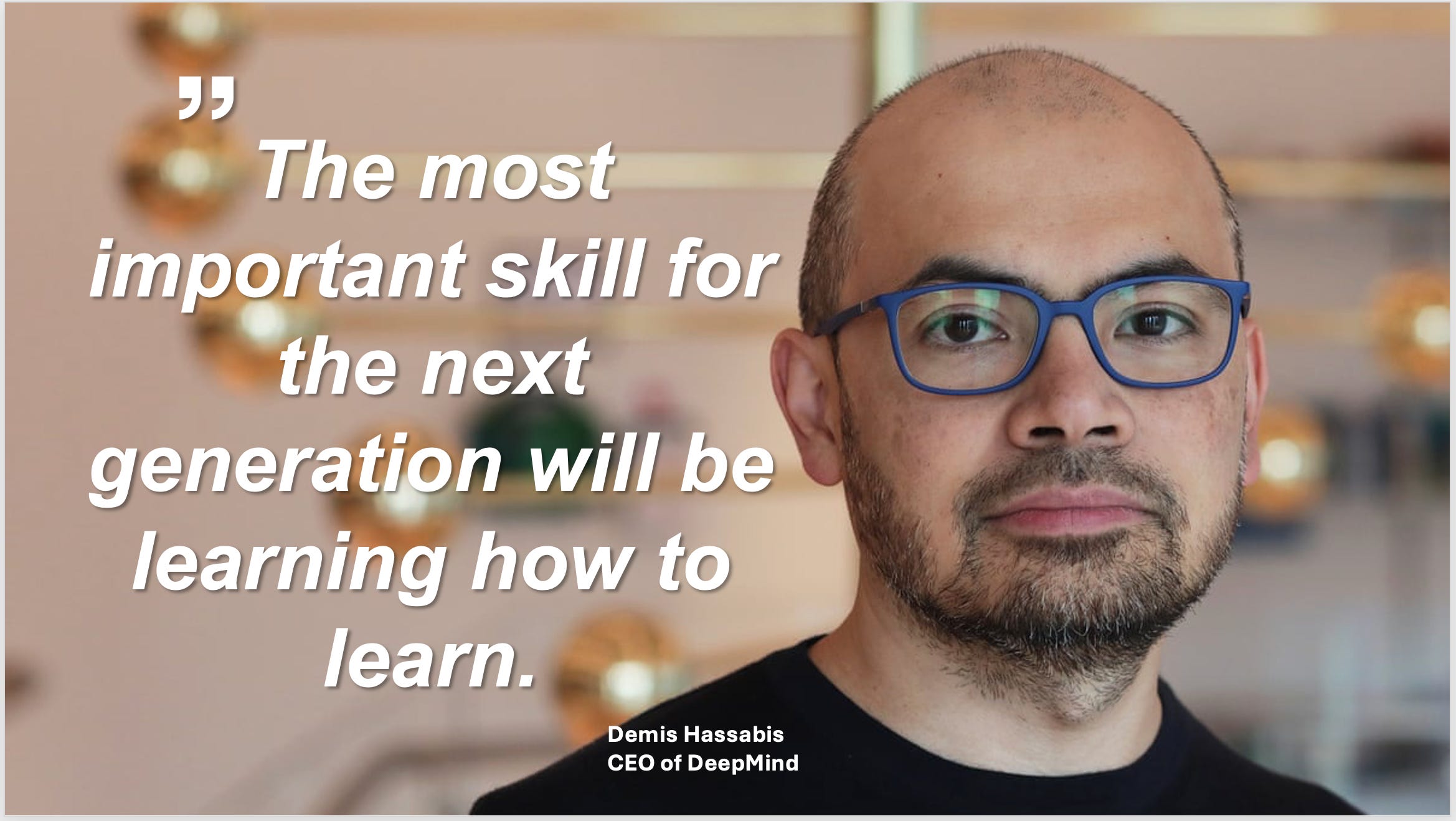
Polanyi told us what the asset is. Drucker told us where the value lives. Hassabis is telling us what to do in response. Across sixty years and three disciplines — philosophy, management, and artificial intelligence — the message is consistent.
The most valuable knowledge inside an enterprise is tacit. The most valuable people are the ones who know how to keep learning. And the most valuable institutions are the ones whose culture treats both as primary assets.
This is a culture, a craft, discipline and mindset shift. A “learning as as product” capability shift is a part of this, as well as a more robust, AI-fueled Information + Instruction approach.
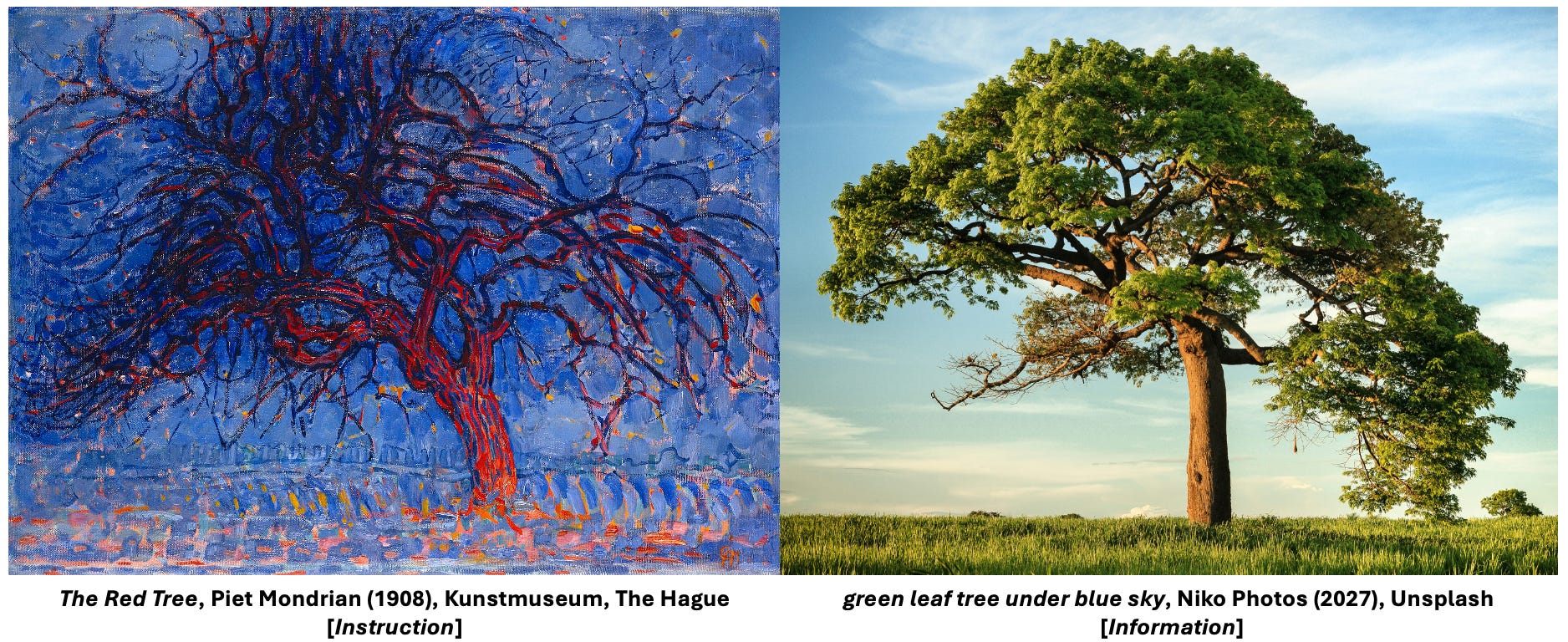
This article opens with an image of two trees. One is a photograph. The other is a painting. Both are accurate. Only one took an expert to make from absolute scratch.
Information is the photograph, with AI being able to analyze each pixel and reproducing it with great efficiency.
Instruction is the painting — still requiring a patient and often imperfect human who knows the craft well enough to teach it.
AI is very good at producing the photograph. Instruction is how we produce the painting.
I’m hopeful we can build new disciplines to produce both.
This article was assisted by Claude Sonnet 4.7.
All em dashes — are mine.
The views and opinions expressed in this article are solely those of the author and do not necessarily reflect the views of the author’s employer or any affiliated organizations.
Licensing
Unless otherwise noted, the contents of this series are licensed under the Creative Commons Attribution 4.0 International license; CC0 1.0 Universal (CC0 1.0) Public Domain Dedication.
Should you choose to exercise any of the 5R permissions granted you under the Creative Commons Attribution 4.0 license, please attribute me in accordance with CC’s best practices for attribution.
If you would like to attribute me differently or use my work under different terms, contact me at https://www.linkedin.com/in/marcsramos/.
Artwork
The Red Tree, Piet Mondrian (1908), Kunstmuseum, The Hague
green leaf tree under blue sky, Niko Photos (2027), Unsplash
Appendix
[A] The theorists meet the KM + Learning + AI product
[B] How WPP measures the success of WPP Open, its AI marketing platform
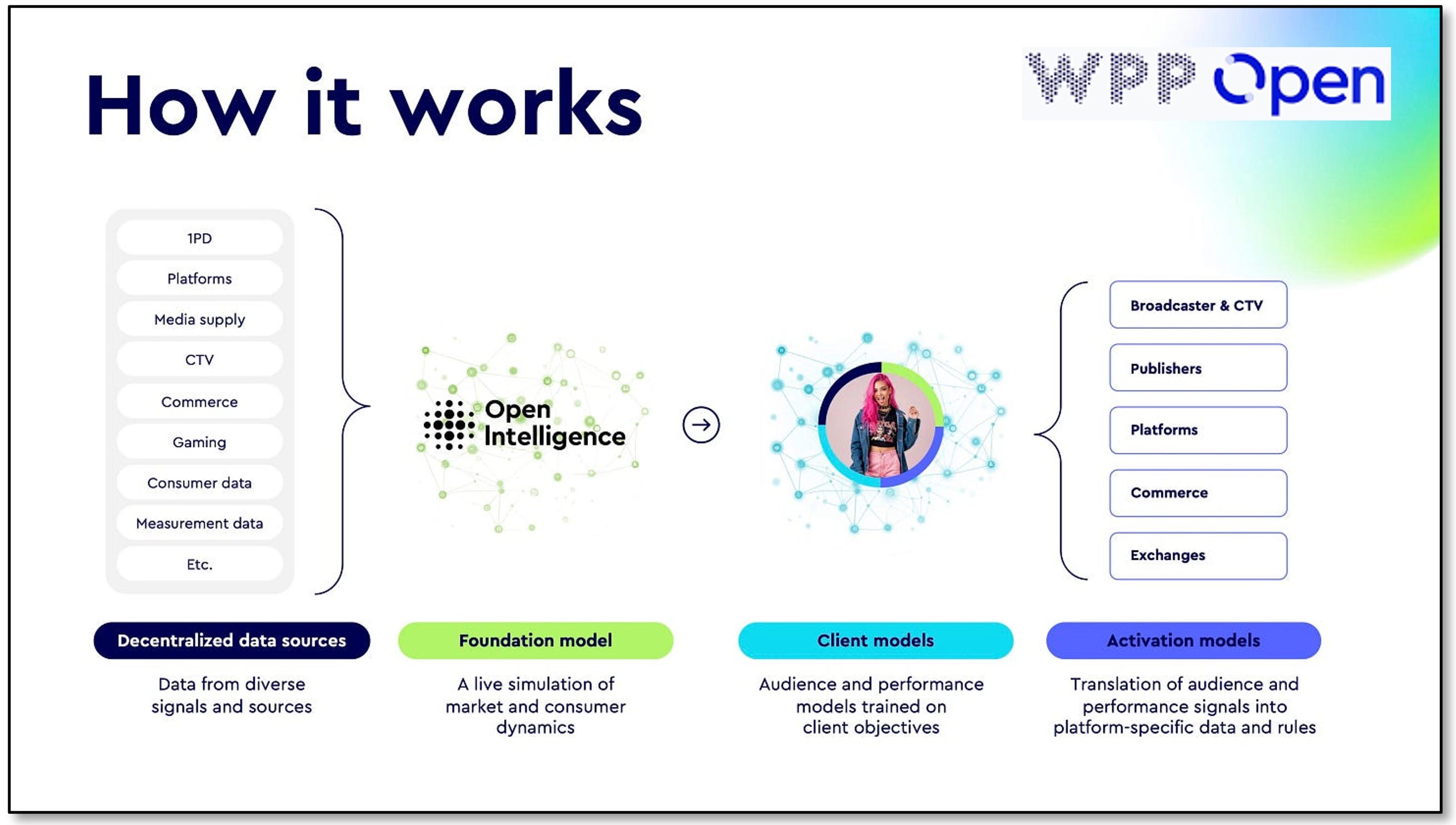
Published results include 14 hours per week saved per team of four (approximately 90 working days per year), a 33-fold content volume increase on the Hawkstone IPA campaign with full product sell-out, and a 23.5% reduction in launch costs paired with 14% faster global delivery and 100% brand compliance across four regions for the Google Pixel launch [18]. These are product success metrics, not training metrics. They measure what the product produced for the business and the user. The same framing applies to L&D and KM in the AI era. The product is capability access. The measurement vocabulary is the one modern product organizations already use.
[C] The four “Human Agency” metrics that should be in every employee survey where the use of AI is expected
Do you still feel ownership of the output?
Do you feel you have a say in which L&D or Talent tasks get automated?
Are you doing the parts of your job that you find most meaningful?
Are you getting better or faster at your craft? Choose one.
References
Ocean Tomo (a part of J.S. Held). (2026, February 12). Ocean Tomo releases 2025 Intangible Asset Market Value Study results. https://oceantomo.com/insights/ocean-tomo-releases-2025-intangible-asset-market-value-study-results/
Polanyi, M. (1966). The Tacit Dimension. University of Chicago Press. https://press.uchicago.edu/ucp/books/book/chicago/T/bo6035368.html
Nonaka, I., & Takeuchi, H. (1995). The Knowledge-Creating Company: How Japanese Companies Create the Dynamics of Innovation. Oxford University Press. https://global.oup.com/academic/product/the-knowledge-creating-company-9780195092691
McKinsey Global Institute. (2012). The Social Economy: Unlocking Value and Productivity Through Social Technologies. McKinsey & Company. https://www.mckinsey.com/industries/technology-media-and-telecommunications/our-insights/the-social-economy
Bargh, J. A., & Schul, Y. (1980). On the cognitive benefits of teaching. Journal of Educational Psychology, 72(5), 593–604. https://doi.org/10.1037/0022-0663.72.5.593
Fiorella, L., & Mayer, R. E. (2013). The relative benefits of learning by teaching and teaching expectancy. Contemporary Educational Psychology, 38(4), 281–288. https://doi.org/10.1016/j.cedpsych.2013.06.001 See also Fiorella, L., & Mayer, R. E. (2014). Role of expectations and explanations in learning by teaching. Contemporary Educational Psychology, 39(2), 75–85.
American Productivity & Quality Center (APQC). Next-Generation Communities of Practice: Schlumberger Ltd. Case Study. https://www.apqc.org/resource-library/resource-listing/next-generation-communities-practice-schlumberger-ltd-case-study
NASA Office of Inspector General. (2012, March 1). Review of NASA’s Lessons Learned Information System (Audit Report IG-12-012). https://oig.nasa.gov/wp-content/uploads/2024/02/IG-12-012.pdf
Argote, L. (2013). Organizational Learning: Creating, Retaining and Transferring Knowledge (2nd ed.). Springer. https://link.springer.com/book/10.1007/978-1-4614-5251-5
Wenger, E. (1998). Communities of Practice: Learning, Meaning, and Identity. Cambridge University Press. https://www.cambridge.org/highereducation/books/communities-of-practice/724C22A03B12D11DFC345EEF0AD3F22A
Davenport, T. H., & Prusak, L. (1998). Working Knowledge: How Organizations Manage What They Know. Harvard Business School Press. https://store.hbr.org/product/working-knowledge-how-organizations-manage-what-they-know/3014
Garfield, S. (2018, February 17; republished 2019, August 18). What is the relationship between structural capital and knowledge management? Medium. https://stangarfield.medium.com/what-is-the-relationship-between-structural-capital-and-knowledge-management-13a898913580
Training Industry. (2024). Think Like a Marketer: Marketing Strategies for L&D. https://trainingindustry.com/articles/strategy-alignment-and-planning/think-like-a-marketer-marketing-strategies-for-ld/
Kirkpatrick, J. D., & Kirkpatrick, W. K. (2016). Kirkpatrick’s Four Levels of Training Evaluation. ATD Press. https://www.td.org/product/book--kirkpatricks-four-levels-of-training-evaluation/111614 (Model originally developed by Donald L. Kirkpatrick in 1959.)
Phillips, P. P., Phillips, J. J., & Toes, K. (2024). Return on Investment in Training and Performance Improvement Programs (3rd ed.). Routledge. https://www.routledge.com/Return-on-Investment-in-Training-and-Performance-Improvement-Programs/Phillips-Phillips-Toes/p/book/9781032754048
American Productivity & Quality Center (APQC). Understanding Knowledge Management Measurement. https://www.apqc.org/resource-library/resource-listing/understanding-knowledge-management-measurement
Brynjolfsson, E., Li, D., & Raymond, L. R. (2023). Generative AI at Work. NBER Working Paper No. 31161. National Bureau of Economic Research. https://www.nber.org/papers/w31161
WPP. (2025). WPP Open: the AI platform for marketing. Published outcomes including Hawkstone IPA and Google Pixel launch. https://www.wppopen.com/ and https://www.wpp.com/en/open
Google. (2024–2025). Meridian: open-source Marketing Mix Modeling. https://business.google.com/us/think/measurement/meridian-marketing-mix-model/
Ellis, S., & Brown, M. (2017). Hacking Growth: How Today’s Fastest-Growing Companies Drive Breakout Success. Crown Business (Penguin Random House). https://www.penguinrandomhouse.com/books/545936/hacking-growth-by-sean-ellis-founder-of-growthhackerscom-and-morgan-brown/
Autor, D. H. (2014). Polanyi’s Paradox and the Shape of Employment Growth. NBER Working Paper No. 20485. National Bureau of Economic Research. https://www.nber.org/papers/w20485