
Learning in the Flow of Context
Co-building customer training at the edge, where they work, via Forward Deployed Learning Design

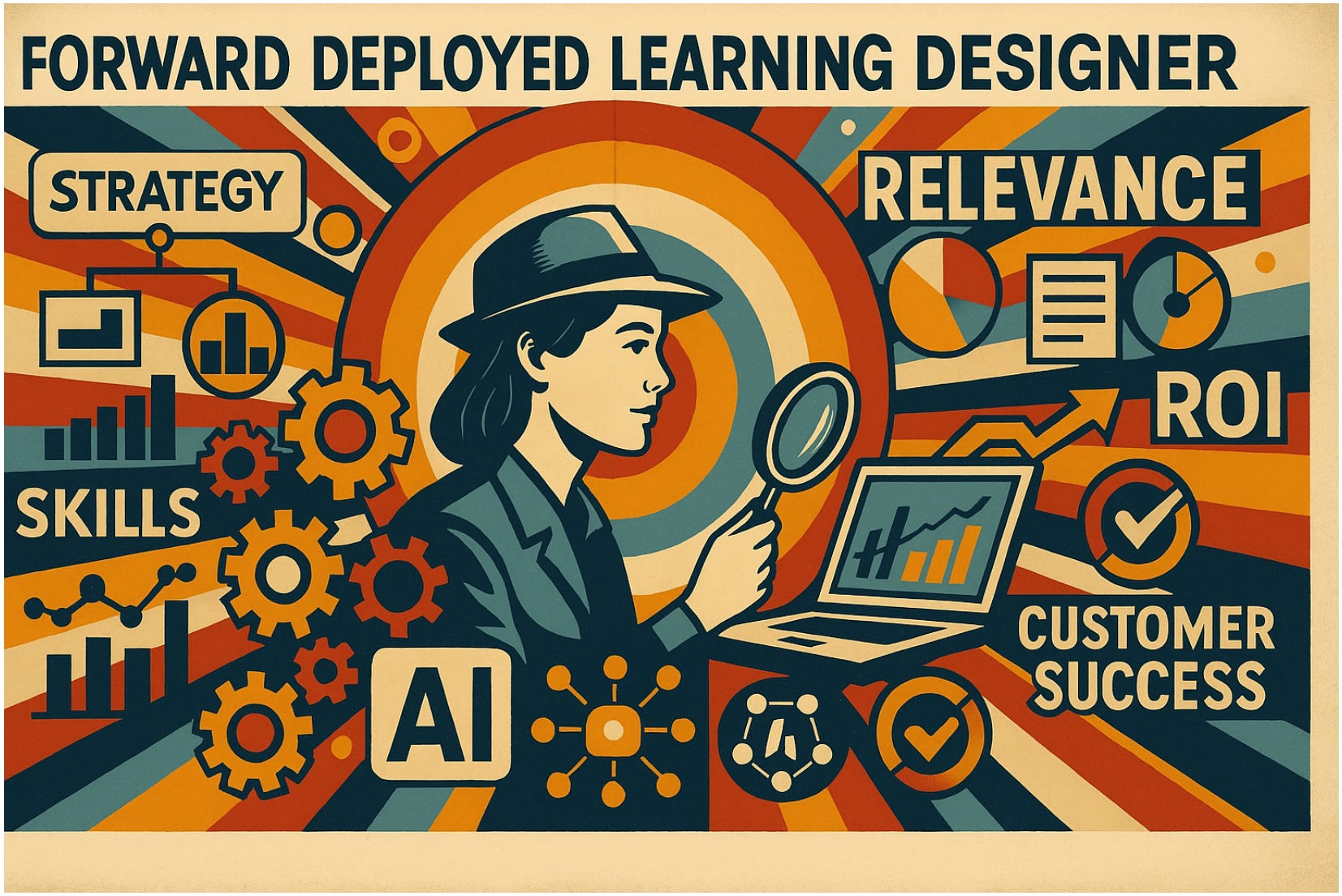
The Forward Deployed Engineer or FDE role was famously inspired by Palantir’s CEO Alex Karp’s observation of how excellent French restaurants operate. The waitstaff is an intrinsic part of the kitchen. If you want to order the wrong wine with the fish, the wait staff will simply tell you no. In order to provide the best experience the delivery mechanism has to be a part of the product, it has to be opinionated, and it has to own that in this case the customer is going to get the best meal even if they don’t know how to ask for it. Karp observed that institutions were not organized to ask for the right software meal and the market forces of the software industrial complex were pumping them with empty calories. Over time Palantir endeavored to set a standard for enterprise technology that would reform the entire market.[1]
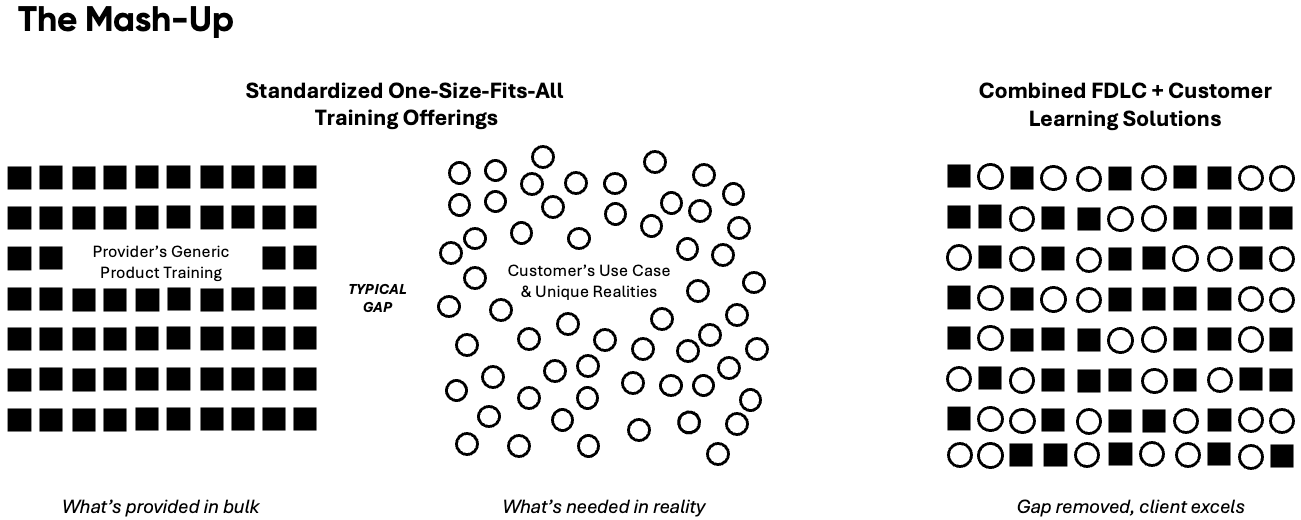
When enterprise customers purchase a complex software platform, the providing B2B company (business-to-business) or vendor typically provides training offerings to help the customer implement and adopt the platform or technology. These vendor offerings are usually pre-built, generic product training programs, courses, and credentialing primarily built to meet the needs of as many customers as possible.
That is, a one-size-fits-all approach.
Yet for many B2B clients, this pre-packaged approach typically meets limited needs. The offerings tend not to address client's every day, unique use cases, workflows, terminology, business objectives and possibly the client’s norms and culture. More so, many enterprise customers purchase complex systems to support their B2B customers’ needs—such as purchasing mining technologies to refine raw materials for their manufacturing clients—leading to a vicious cycle of underwhelming investment.
The overall result? Poor adoption, slow adoption, additional resource requirements and increased budgets, and frustrated client teams. And this is becoming an all too common, increasing situation as must buy innovative technologies like AI, robotics, biotech etc. are becoming required purchases to stay competitive.
For Learning and Development or L&D teams, this engagement model or relationship is often transactional: sell the training, deliver the course, issue certifications, and move on until the next version(s) of product training are released. As shared, the content is standardized by necessity, designed to serve customers in bulk, and any customization is often left to the customer’s internal documentation and training teams.
And it’s not uncommon that the gaps between what the training covers and what the customer actually needs are tolerated and left unfulfilled. The training might initially check the box, but it rarely meets the clients complete, unique, and growing needs.
Yet, a potential solution to consider…
The Forward Deployed Engineer
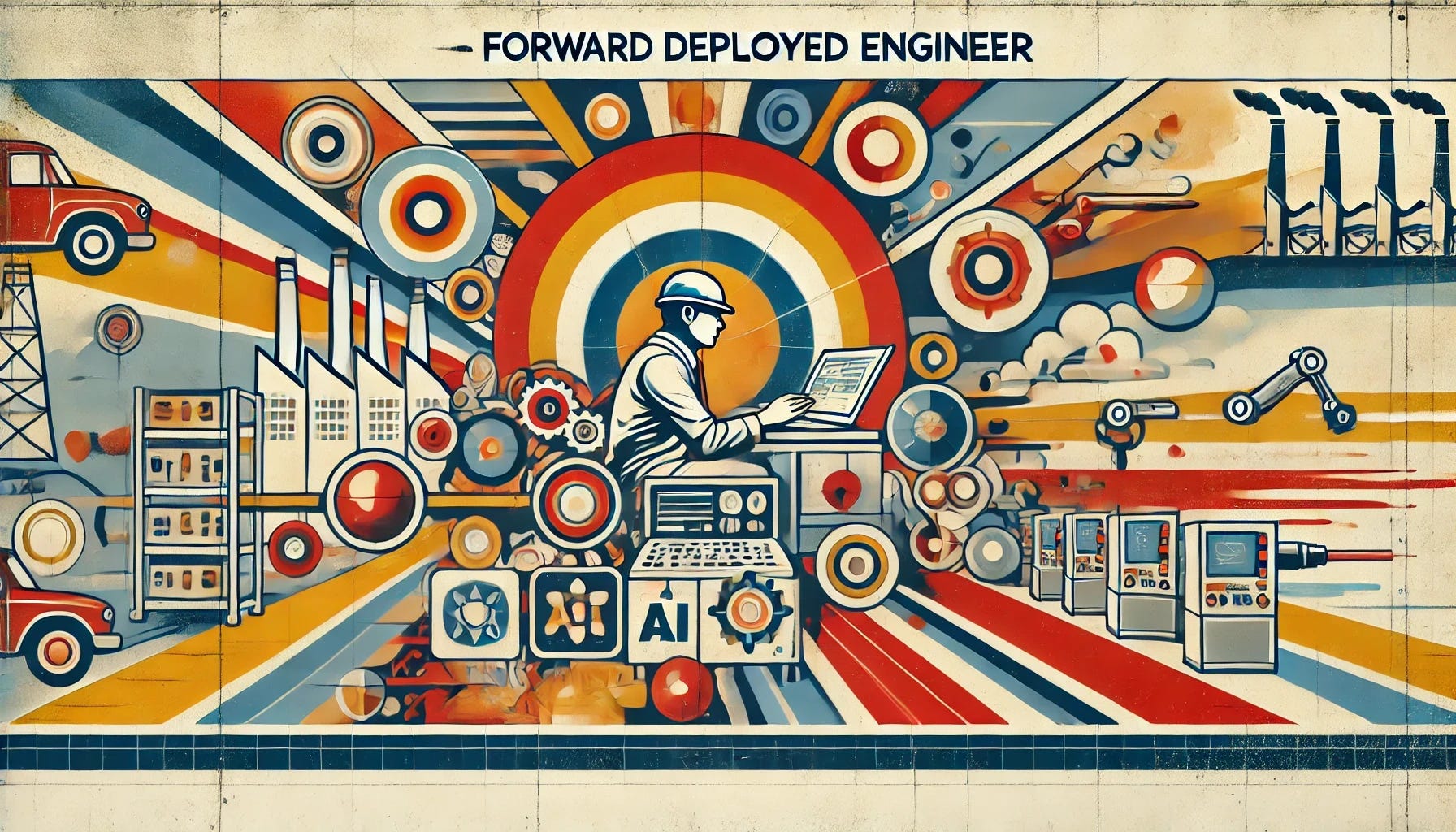
Image by Max Dauber.
Palantir is a military technology company known for providing a relatively unique “Forward Deployed Engineer” model, or FDE. With this approach, Palantir places their technology experts deep within the client’s everyday work to understand specific needs, determine how Palantir’s solutions can best adjust to customer realities, and “customize” their solutions on the spot, and in real-time.
Palantir’s FDEs literally sit with clients—in offices, workflows and real warzones—to solve problems on the spot and clarify true moments-of-need. They don’t just hand over a requirements documents or implementation guidelines, but they identify any gaps of Palantir’s implementation with the realities of the customer’s world.
“That's like the exciting thing is the Palantir model, which I think is a fantastic model. And why is that? Because I think you really need to help customers and partners really understand the benefits of any product you're creating, but not just the technology, but even how to use the technology in a workflow.” - Microsoft CEO Satya Nadella
The solution to consider, or, that is, the L&D solution to consider… What if a vendor or supplier’s L&D team could replicate Palantir’s Forward Deployed Engineer model, yet instead of customizing the tech, a new Forward Deployed Learning Designer role would be inserted within the client’s teams to address similar “at the edge” gaps?
Traditional training is often cookie-cutter and pre-assembled, whereas the FDLD model is customer-centric and co-created. Instead of “Here’s what our course covers,” the message becomes “Let’s build the learning experience you need together.” The engagement is ongoing and iterative: an FDLD doesn’t disappear after a one-day workshop, they remain embedded long enough to refine the material based on feedback and evolving needs.
Just as Palantir’s engineers quickly prototype solutions to match the client’s mission, an FDLD rapidly tailors learning modules by mixing the vendor’s standard content with the client’s own use cases, terminology, and data. This also leads to reusable “Lego blocks” for similar customer needs, similar segments or verticals, and similar use cases.
Introducing the Forward Deployed Learning Designer
By embedding learning designers directly with key customers, companies can co-create training content that reflects each client’s projects, terminology, and culture, ensuring the training actually fits. This “FDLD” approach may be a solution to standardized, generic customer training (which will probably continue to exist) and unlock new benefits for both the customer and the provider. However…
What’s the difference with a training contractor or learning services provider?
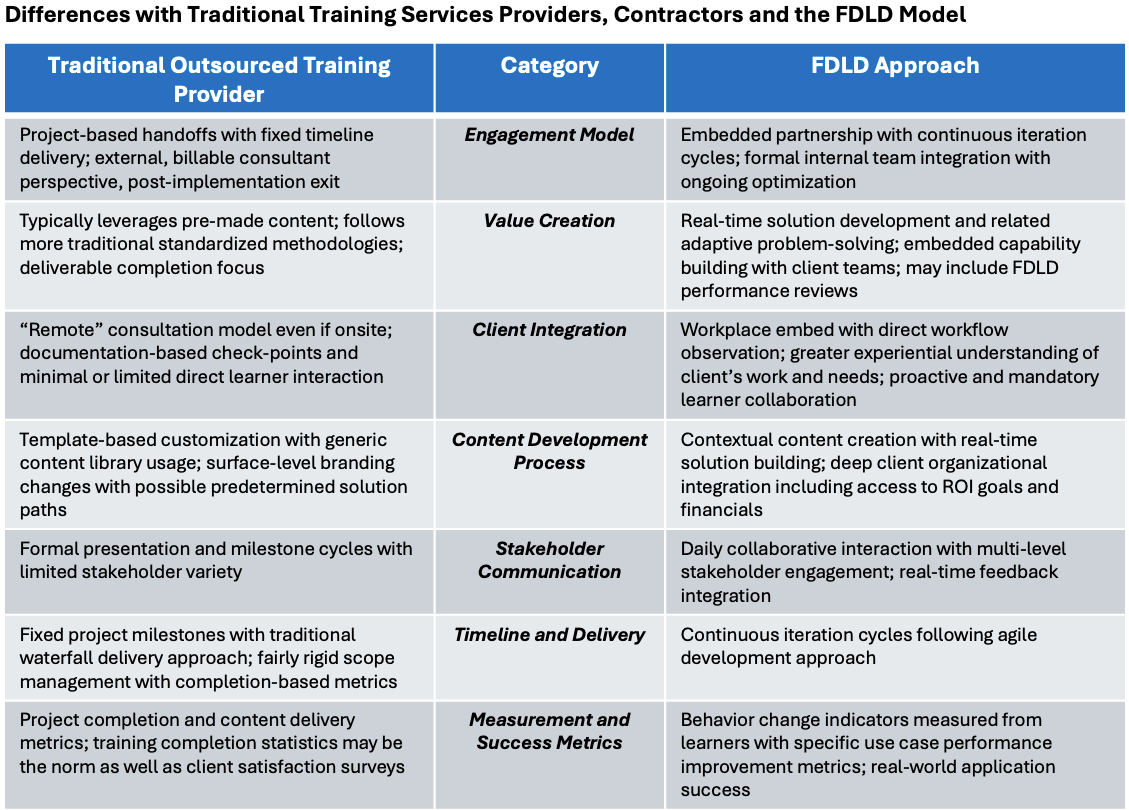
The Forward Deployed Learning Designer model represents a significant departure from traditional learning consultancy approaches, offering distinct advantages that address critical limitations of conventional "build-and-handoff" consulting services. Traditional learning consultants follow a standardized process where they typically customize content with surface-level branding with set, milestone-driven outputs, and exit once implementation is complete. This approach creates fundamental problems:
Generic Content Foundation: Off-the-shelf content libraries lack organizational specificity and fail to address actual workflow challenges
Handoff-Based Inefficiencies: Consultants work in isolation and transfer completed work without ongoing collaboration, creating delays and reducing quality
Limited Domain Understanding: External consultants lack deep understanding of operational nuances, regulatory requirements, and workflow complexities
Project-Based Limitations: Fixed timelines with complete exit provide no mechanism for continuous improvement or adaptation
Core Pillars and Customer Immersion
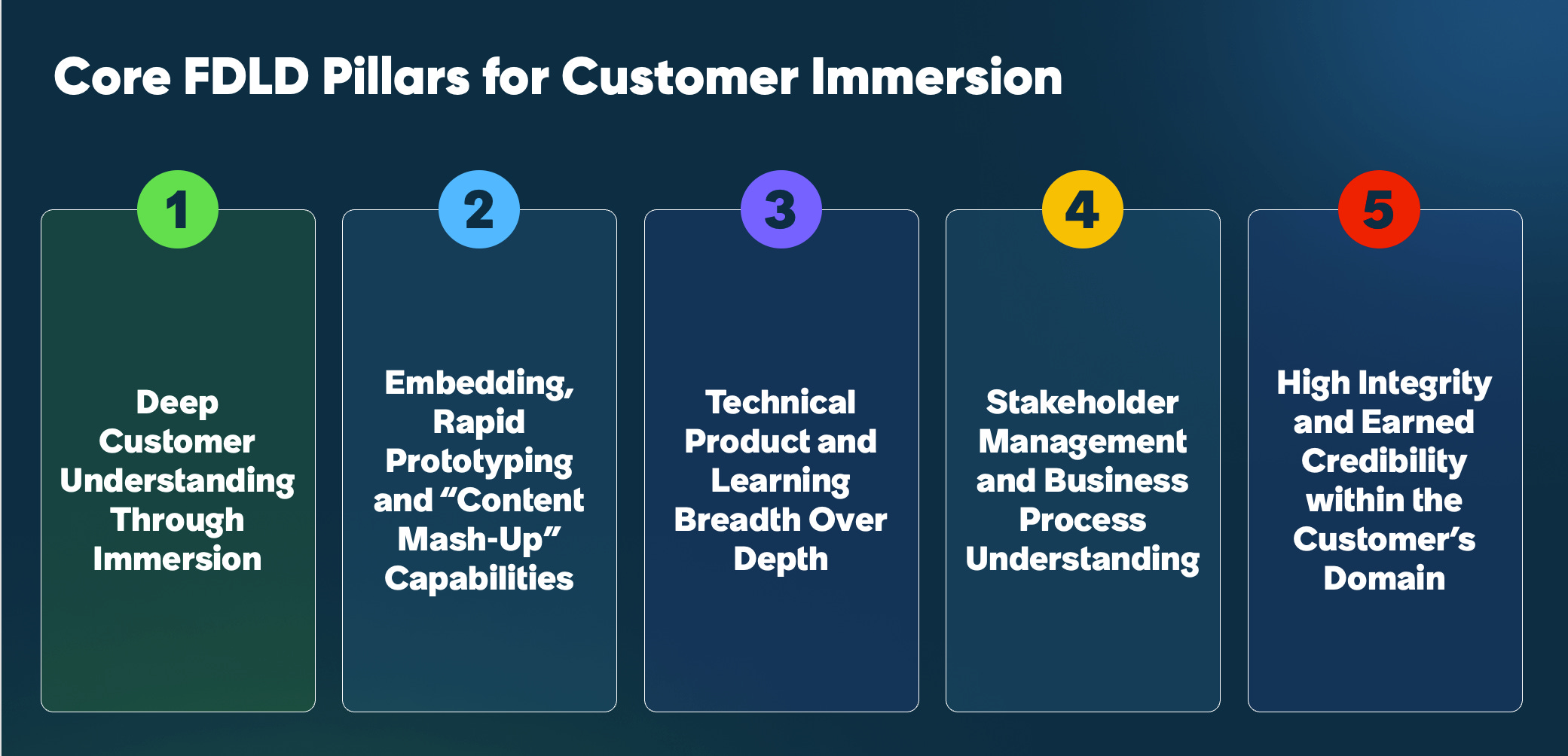
Successful FDLD programs are built on several fundamental pillars, with deep customer and learner obsession at their heart. I suggest 5 key elements that define a modern FDLD approach:
📝 1. Deep Customer Understanding Through Immersion
Traditional learning designers work from offices, receiving requirements through stakeholders with minimal-to-moderate direct end-user or end-learner interaction. FDLDs embed themselves in their customer’s learner's world—factory floors, operations centers, field sites—gaining insights that traditional models miss. They understand not just what learners say they want, but what they actually need based on firsthand workflow experience.
📝 2. Embedding, Rapid Prototyping and “Content Mash-Up” Co-Creation
The ability to quickly create working learning prototypes is crucial. The FDLD would work with the client’s L&D team and subject matter experts to blend the vendor’s technical curriculum with the client’s context. That could mean replacing generic case studies with the client’s actual project scenarios, using the client’s data in hands-on exercises, and adopting the company’s nomenclature in all materials.
🔧 3. Technical Product and Learning Breadth Over Depth
Today’s FDLDs requires broad learning technology understanding to solve learner problems effectively, as well as breadth with their own product line. They're learning design Swiss Army knives specializing in combining and modifying what would be disparate vendor vs client assets into complementary paths, and partnering for success measures, analytics and insights.
🔄 4. Stakeholder Management and Business Process Understanding
Effective communication with learning and business stakeholders is crucial. FDLDs present ROI metrics to executives, design learning pathways with L&D teams, and facilitate sessions with frontline workers. They speak multiple "languages": learning science with designers, business metrics with executives, practical application with end users. They must understand both learning mechanics and business operations.
📈 5. High Integrity and Earned Credibility within the Customer’s Domain
FDLDs foster a continuous learning partnership. They might establish an internal “community of practice” at the client – aligning with the client’s L&D for sustained enablement. In essence, the FDLD becomes a trusted advisor on how to leverage the software, very much like a forward-deployed engineer becomes a go-to problem solver beyond just the initial project.
New Skills and Mindsets for FDLDs
Adopting an FDLD model means cultivating a new breed of learning professionals. These individuals combine skills from multiple domains:
Technical Product Mastery: An FDLD knows the ins and outs of their software or SaaS product. They can speak the language of engineers and understand the product’s capabilities deeply, so they can teach it and spot opportunities to push its use.
Instructional Design & Adult Learning: At their core, FDLDs are learning designers. They apply sound instructional design principles to create effective training, but with agility.
Consultative and Domain Expertise: Much like a consultant, an FDLD must quickly grasp the client’s industry and business processes. They essentially act as a translator between the generic product functionality and the client’s sector-specific application of it.
Empathy and Change Management: FDLDs immerse themselves in the client’s environment, so they must be empathetic and adept at change management. This empathy helps them re-design and combine assets to truly addresses user pain points, lowering resistance to new processes.
Agility with Technology (including AI): Because customization and content retrofitting are key, FDLDs must leverage technology to accelerate content development. Comfort with tools for rapid content creation, analytics to monitor learning progress, and even AI assistants is increasingly important.
In essence, an FDLD wears many hats – part product expert, part teacher, part business analyst. This is a step beyond the current approach where roles might be siloed (e.g., product trainers deliver pre-made content, while consultants handle unique customization separately). The FDLD blends these roles, much like Palantir’s forward-deployed engineers blend software engineering with on-site consulting in one role.
Benefits: A Win–Win for Customer and Provider
A forward-deployed learning model creates compelling benefits for both parties involved:
For the Customer Organization:
Highly Relevant Learning: The most obvious benefit is training that makes sense to their employees. Every example, exercise, and quiz feels like it was built for their job, not for a generic user. Learners stay engaged because the content mirrors their daily reality – their projects, their datasets, their acronyms.
Faster Time to Proficiency: Tailored training shortens the learning curve. Employees can go from onboarding to competent usage of the product much faster when training focuses on the exact use cases they’ll encounter. They’re not wading through generic vendor-provided modules to find what’s useful.
Deeper Product Utilization: Often customers unfortunately only use a fraction of a software’s features. FDLDs, by aligning training with business needs, can reveal features and workflows that address those needs. The result is broader and more sophisticated use of the product.
Continuous Support and Partnership: With an FDLD as an extended team member, the relationship feels less like vendor training and more like having an in-house expert who is up-to-date on the software’s latest features and how they fit the business. Especially for large enterprises with their own L&D, the FDLD works in tandem with them, augmenting their capacity with deep product expertise.
For the Providing Company (Vendor):
Stronger Customer Loyalty & “Stickiness”: By further integrating the product into the client’s very workflow and even culture, the vendor cements its position. The training itself becomes part of the customer’s intellectual fabric – something competitors would struggle to replicate. This creates a moat or lock-in effect: customers are far less likely to churn because switching products would mean losing not just a tool but a tailored learning framework.
Product Improvement Insights: Just as Palantir’s embedded engineers feed insights back to headquarters (informing the product roadmap), FDLDs become a conduit of feedback from the field. They see first-hand which features confuse users, which use cases are gaining traction, and what new needs are emerging. In this way, FDLDs help their company continually refine both its product and its education offerings in line with real-world usage.
Differentiated Service Offering: In a crowded SaaS market, how do you stand out? Forward-deployed learning could become a unique selling point. It’s not just software as a service, but software with a service. This can tilt deals in the vendor’s favor when enterprise buyers compare vendors.
Revenue Opportunities: If positioned correctly, FDLD services could be a new revenue stream. Some companies might bundle a certain level of FDLD support into enterprise licenses, while others might offer it as an add-on consulting service.
Reusability and Scalable Frameworks: Each FDLD engagement, while customized, also builds re-usable assets for the vendor. Perhaps the FDLD serving a healthcare client develops a training simulation for hospital workflows – this could become a template for other healthcare clients (with appropriate tweaks). Over time, a library of industry-specific learning modules and best practices can emerge. Essentially, FDLDs help the company capture “on the edge” knowledge and package it into structured frameworks that benefit the next customer.
Measuring Impact in an FDLD Model
Traditional training metrics might include course completion rates, certification exam scores, or satisfaction surveys. While those are still useful, a forward-deployed approach enables more meaningful measures of customer value and impact:
Adoption and Utilization Metrics: We can track the customer’s usage of the software before and after FDLD-led training. For example, feature adoption rates: are users now leveraging more of the product’s advanced features post-training?
Time-to-Value: How quickly can the customer achieve key milestones with the software? FDLDs aim to compress this timeline. We might measure time from purchase to first successful project completion on the platform, or time for a new user to move from novice to certified power user. Shorter times here mean the tailored learning was effective.
Performance Outcomes: Ultimately, training is a means to an end – better performance. With custom learning in place, the client can look at business KPIs impacted by software usage. While many factors contribute to such outcomes, an FDLD can help link training to these metrics by designing learning objectives around them.
Customer Satisfaction & Renewal Rates: An obvious but important measure – are the clients happier and are they renewing contracts? Net promoter score (NPS) specifically for the training experience can be measured. We’d expect that organizations receiving an FDLD service rate their overall partnership with the vendor higher.
Internal L&D Integration: If the FDLD model works, over time the client’s L&D team will start adopting the vendor’s materials and approaches in their broader internal programs. The number of client-specific modules co-developed—ideally aligned with the provider’s “content modularization” strategy—can indicate success. Essentially, the FDLD’s work should become part of the fabric of the client’s ongoing training ecosystem.
AI: A Force Multiplier for Forward-Deployed Learning
No contemporary discussion is complete without considering the role of AI, especially as “agentic AI” and advanced generative models rise. How could AI bolster the FDLD approach?
Personalized Content Generation: One of the time-consuming parts of customization is creating examples, analogies, or scenario-based exercises that mirror the client’s context. Large language models like ChatGPT, Perplexity, and Claude can assist FDLDs by generating draft case studies or practice questions using the client’s terminology. For instance, an FDLD could prompt an AI: “Create a scenario using our software in XYZ customer’s manufacturing plant context, and the customer’s assembly line learning materials, and provide a narrative to build an exercise around this blend”. Mash-up indeed.
Adaptive Learning Paths: Imagine each employee at the client having an AI-driven learning coach that knows their role and skill level. The FDLD could deploy such an AI tutor, which draws from both the standard training content and the custom additions. As the employee goes through training, the AI agent monitors their progress and autonomously adjusts, offering more practice on areas they struggle with, or bringing in additional context.
Scaling the FDLD’s Reach: An FDLD can’t be everywhere at once – but AI agents can help scale their impact. For example, a chatbot integrated into the client’s knowledge base that can provide new insights and even challenge the learner along the way; i.e., a “Socratic” method similar to Khan Academy’s Khanmigo tutor.
Data-Driven Insights: AI can sift through learning data (quiz results, usage stats, feedback comments) far faster than a human. It can find patterns like “for our product training modules combined with our client’s documented use cases, do students pass more complex tests with this merged instruction than non-combined lessons?” These insights allow the FDLD to proactively adjust the program or reach out to certain groups for additional support.
Content Maintenance, Version Controls, and Updates: Software products change rapidly, and so must training. AI can assist in updating content; e.g., automatically suggesting revisions to training manuals when a new version of the software is released by comparing release notes to the training material. This frees up both FDLDs and their partner customer L&D colleagues.
In short, AI is not a replacement for the FDLD, rather, it’s a force multiplier. The human element of understanding the client’s culture, building trust, and empathizing with learners remains critical. For companies worried about AI automating away L&D roles, this model shows how embracing AI augments the role: the FDLD leverages AI, but their unique blend of human skills remains irreplaceable.
Billing Model: Premium Service or Standard Offering?
One strategic consideration for implementing FDLDs is whether to make them a billable service or a complementary value-add. There are advantages to both approaches:
FDLD as a Billable Service. In this model, the vendor offers forward-deployed learning design as a paid engagement (perhaps as part of a professional services package). The advantage here is direct revenue. It monetizes the significant effort of customization, which can fund a larger team of FDLDs and justify deep engagements. Being billable positions FDLD support as a premium, consultancy-like offering, which can even enhance the brand’s cachet.
FDLD as a Complimentary/Embedded Service. On the other hand, including FDLD support as part of the standard customer success package can dramatically boost customer satisfaction and differentiation. It becomes a value-added feature of doing business with the vendor (“white-glove enablement for every enterprise client!”). The obvious benefit is reduced friction – clients aren’t deterred by extra costs. This could be crucial for new customers who are on the churn or renewal fence; knowing they’ll get customized training baked-in could tip the scales.
Many companies might adopt a hybrid approach: basic FDLD engagement included, with deeper or longer engagements available at a cost. For instance, the first bespoke onboarding program could be free, but ongoing dedicated FDLD consulting beyond a certain period might be billable; e.g., upsell and cross-sell opportunities. These balances providing immediate value with maintaining a path to monetization for sustained services.
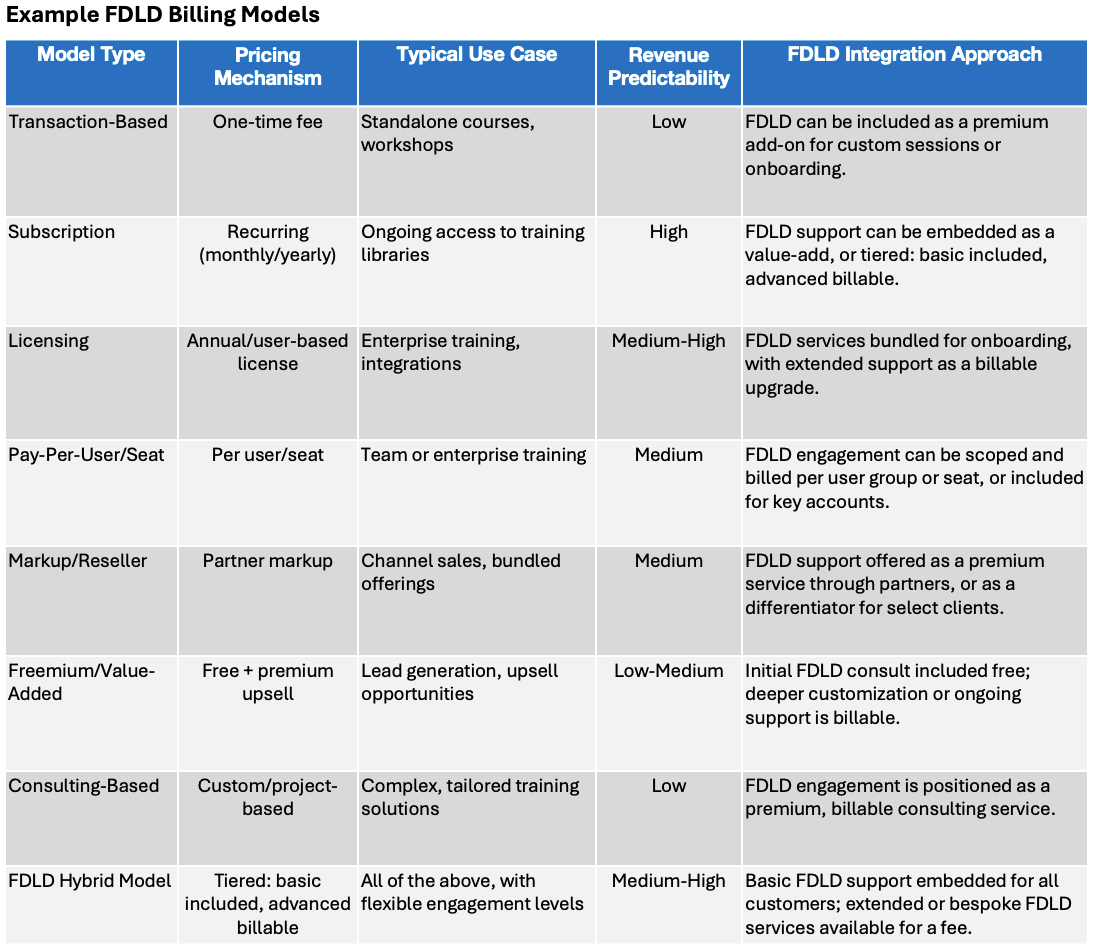
From a business strategy perspective, making FDLDs billable emphasizes it as a distinct service (with its own P&L), while making it complimentary treats it as an extension of customer success (measured by retention and expansion). Either way, the ROI must be clear, and often it is, given the earlier-discussed impact on adoption and loyalty.
A New Path for L&D Professionals in the AI Era
It’s no secret that traditional L&D roles are under pressure. With the rise of AI, some routine training tasks like content creation, basic coaching, or FAQ answering are increasingly automated. This can be unsettling for corporate trainers and instructional designers: Will AI chatbots and auto-generated courses make me obsolete? The FDLD model offers an exciting answer: evolution instead of obsolescence.
Forward Deployed Learning Designers represent an elevated role that leverages traditional L&D skills and amplifies them with strategic and technical acumen. Rather than being replaced by AI, FDLDs use AI and focus on what humans do best – building relationships, understanding nuanced needs, and creative problem-solving.
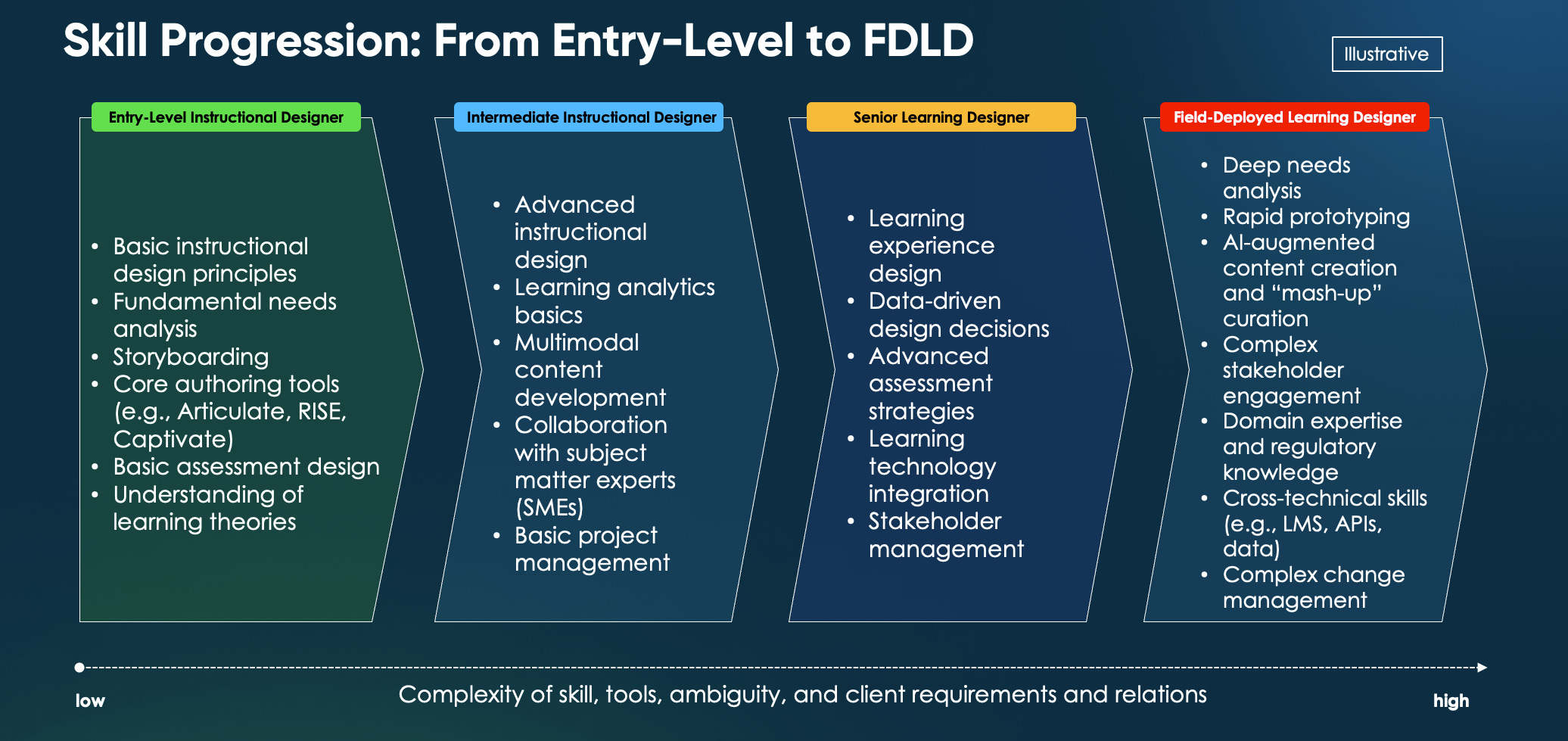
For a seasoned trainer or instructional designer, transitioning to an FDLD role means enhancing their skill set in areas like data analysis, consulting, and technology integration. In practice, a traditional L&D professional might already excel at needs analysis and course design; as an FDLD, they take it further by conducting on-site (or in-depth) discovery with clients and then designing in direct response to that discovery.
Their facilitation skills expand into facilitation of cross-functional meetings between the vendor and client teams, for example. Their content development savvy is now applied in a consultative context possibly creating new learning modalities such as embedding the provider’s product demo videos into the customer’s real use cases, and having an AI tool like NotebookLM provide a new audio narrative.
Moreover, FDLDs can help insulate L&D roles from automation by focusing on tailored, more complex design rubrics. The FDLD is that guiding force. They ensure that human creativity and empathy remain at the center of learning. In doing so, they carve out a NEW domain within our L&D community that is augmented (not replaced) by AI: the algorithms handle the repeatable grunt work, while humans drive the strategy and relationship aspects.
This model could even be a career lifeline for trainers from industries where automation is making standard content delivery less central. By becoming FDLDs, they shift from being deliverers of content to designers of experiences and solvers of problems. It’s a future-proofing move I think, one that aligns with how technology is changing work. Companies adopting FDLD programs might retrain some of their existing training staff into these roles, preserving institutional knowledge while adding new capabilities. It’s a win for the professionals who grow their value, and for the company who retains talent and meets customers’ evolving needs.

Palantir’s Forward Deployed Learning Designer model directly addresses the shortcomings of traditional training by attacking the problem at its source: lack of RELEVANT context, lack of embedding REAL customer and end-user use cases, and ACCURATE personalization and skill-definition based on adoption challenges. By embedding with clients, FDLDs ensure that training isn’t an afterthought or a checkbox, but a strategic lever tightly aligned to the client’s success.
This approach tackles the very problems that have plagued enterprise training programs for years – low engagement, poor knowledge transfer, slow adoption – and flips the paradigm to one of high-touch, high-relevance learning. Companies that deploy FDLDs are effectively saying, “Your success is our success, and we’re willing to invest the (human + AI) expertise to prove it.” The benefits speak for themselves: more proficient and satisfied users, deeper usage of the product, and a relationship that goes beyond vendor-customer to true partnership.
It’s no coincidence that tech leaders laud models like Palantir’s FDE as “fantastic”, they see that building solutions WITH the customer, rather than for the customer. The FDLD is not a consultant dropping advice, but a builder embedded in the customer’s context, delivering the learning customers truly need, when they need it. In doing so, this model creates, again, a durable competitive moat.
When a client’s workforce is trained on a platform in a way that meshes so intimately with their daily operations, the platform becomes indispensable.

For SaaS and tech companies, embracing FDLDs could transform customer success metrics and secure long-term growth, and long-term, predictable revenue growth from your Learning Products and FDLD services. For customers, it means finally getting the promised value out of sophisticated tools, through training that’s as unique as their business.
And for L&D professionals, it lights up a path to remain not just relevant but pivotal in an AI-accelerated future.
Acknowledging leveraging Perplexity, Gemini, ChatGPT, and Claude for research, formatting, testing links, challenging assumptions and aiding the creative process.
The views and opinions expressed in this article are solely those of the author and do not necessarily reflect the views of the author’s employer or any affiliated organizations.
LICENSING
Unless otherwise noted, the contents of this series are licensed under the Creative Commons Attribution 4.0 International license.
Should you choose to exercise any of the 5R permissions granted you under the Creative Commons Attribution 4.0 license, please attribute me in accordance with CC's best practices for attribution.
If you would like to attribute me differently or use my work under different terms, contact me at https://www.linkedin.com/in/marcsramos/.
NOTES
[1] Sorry, that isn't an FDE. The replicants take the form but not the function, and miss the soul

ADDITIONAL SOURCES
Reddit. Learning Consultants vs IDs? r/instructionaldesign. https://www.reddit.com/r/instructionaldesign/comments/10d8b5d/learning_consultants_vs_ids/. Accessed July 6, 2025.
eLearning Industry. Is Instructional Design a Good Career? What Are the Benefits? https://elearningindustry.com/is-instructional-design-a-good-career-benefits. Accessed July 6, 2025.
Learning Experience Design. The Instructional Design vs. Learning Experience Design Myth. https://www.learningexperiencedesign.com/blog/instructional-design-vs-learning-experience-design. Accessed July 6, 2025.
Tucker C. Is Instructional Design the Right Career? Experiencing Elearning. https://www.christytuckerlearning.com/is-instructional-design-the-right-career/. Accessed July 6, 2025.
Training Industry. Demystifying Learning and Development Roles in Instructional Design. https://trainingindustry.com/articles/learning-technologies/demystifying-learning-and-development-roles-in-instructional-design/. Accessed July 6, 2025.
LinkedIn. Are the Professions (Disciplines?) of Educational Developer and Learning Designer the Same? https://www.linkedin.com/pulse/professions-disciplines-educational-developer-learning-designer-marie/. Accessed July 6, 2025.
Training Industry. Ten Business and Revenue Models for Corporate Training Companies. https://trainingindustry.com/articles/strategy-alignment-and-planning/ten-business-and-revenue-models-for-corporate-training-companies/. Accessed July 6, 2025.
Stripe. Billing models: A guide for businesses. https://stripe.com/resources/more/billing-models. Accessed July 6, 2025.
Northpass. How to Turn Training Into Recurring Revenue: 3x Growth Playbook. https://www.northpass.com/blog/recurring-revenue-training. Accessed July 6, 2025.
CloudBolt. MSP Pricing Models: Strategy & Best Practices. https://www.cloudbolt.io/blog/msp-pricing-models/. Accessed July 6, 2025.
eLearning Industry. AI-Driven Content Creation: Your Ultimate Guide to eLearning Success. https://elearningindustry.com/ai-driven-content-creation-ultimate-guide-elearning-success. Accessed July 6, 2025.
SmythOS. Revolutionizing Education with Knowledge Graphs: Key Concepts and Benefits. https://smythos.com/ai-glossary/knowledge-graph-in-education/. Accessed July 6, 2025.
Xenia. The Complete Guide to Front-of-House Restaurant Training. https://www.xenia.team/restaurant/front-of-house-training. Accessed July 6, 2025.
Webstaurant Store. Front of House (FOH) vs. Back of House (BOH). https://www.webstaurantstore.com/blog/3861/front-of-house-vs-back-of-house.html. Accessed July 6, 2025.
Amazon Web Services. How the AI for Teaching & Learning Framework on AWS is Transforming Education. https://aws.amazon.com/blogs/publicsector/ai-for-teaching-learning-framework/. Accessed July 6, 2025.
Towards Data Science. What is Embedding? Embeddings in Machine Learning Explained. https://towardsdatascience.com/what-is-embedding-6c5d71b5e6e3. Accessed July 6, 2025.
Fiddler AI. The Advantage of Language Model-Based Embeddings. https://www.fiddler.ai/blog/the-advantage-of-language-model-based-embeddings. Accessed July 6, 2025.
Digital Learning Institute. Exploring AI in eLearning Content Creation. https://digitallearninginstitute.com/blog/ai-in-elearning-content-creation. Accessed July 6, 2025.
EdSurge. Knowledge Graph Helps Build AI Rooted in Learning Science. https://www.edsurge.com/news/2023-09-21-knowledge-graph-helps-build-ai-rooted-in-learning-science. Accessed July 6, 2025.
Edutopia. Revealing an AI Literacy Framework for Learners and Educators. https://www.edutopia.org/article/ai-literacy-framework-learners-educators. Accessed July 6, 2025.
Very interesting and practical idea. Thank you.